

After working closely with business insurance clients for more than 7 years, one thing has become very clear to me. Cyber risk is no longer a distant or theoretical issue. It is not a problem faced only by big tech companies or large corporations. Today, cyber threats affect everyday businesses too. Accounting firms, medical clinics, online shops, manufacturing units, logistics companies, and even small family-run service businesses are all at risk.
What has changed the most in recent years is not only how often cyberattacks happen but also how serious the damage has become. When computer systems stop working, businesses do not just lose data. They lose customer trust, valuable time, regular income, and sometimes the ability to run their business at all. This is where cyber security insurance coverage becomes important. It is not a marketing term. It is a financial support system that helps businesses survive a major cyber event.
I will provide you information based on real experience working with cyber insurance claims. It comes from dealing with confused business owners, situations where coverage was denied, and cases where the right insurance helped companies recover successfully. The goal is simple. To explain what cyber security insurance actually covers, which businesses in the USA truly need it, how it works in real-life situations, and how to choose coverage that will not let you down when it matters the most.
What Cyber Security Insurance Coverage Really Means
Cyber security insurance coverage is not a magic shield that stops hackers. It’s financial protection for when something goes wrong digitally and your business suffers real damage.
In simple terms, it helps pay for the mess after a cyber incident. That mess can include stolen data, locked systems, customer lawsuits, regulatory fines, business downtime, and the experts you’ll need to fix everything.
Many people assume it’s just data breach insurance. That’s only part of it. Modern cyber insurance policies are broader and more complex.
At its core, cyber security insurance coverage usually responds to:
- Unauthorized access to systems
- Data theft or exposure
- Ransomware and extortion attacks
- Network outages caused by cyber events
- Legal and regulatory fallout
What matters is not the label, but what the policy actually pays for when a real incident hits. I’ve seen two policies with the same name behave very differently during claims.
Why Businesses in the USA Actually Need Cyber Insurance
- Stricter Data Laws – If customer or employee information is exposed, businesses must notify affected parties. These notifications cost money even before any legal claims arise.
- Ransomware Targets All Sizes – Cyberattacks are no longer limited to large corporations. Local clinics, construction companies, online retailers, and accounting firms are all at risk. Size does not guarantee safety.
- Client and Vendor Requirements – Many contracts now require proof of cyber insurance. Without coverage, businesses may lose deals or partnerships.
- Expensive Downtime – A locked system for a few days can severely impact cash flow. Cyber security insurance coverage often helps cover lost income during recovery, allowing businesses to focus on resuming operations.
Real-Life Scenarios I’ve Seen (No Hypotheticals)
Let me share a few situations that reflect real patterns, without naming businesses.
A Small Medical Practice Hit by Ransomware
A five-doctor clinic had its patient management system locked overnight. Hackers demanded payment. The cyber insurance policy didn’t just cover negotiation experts, but also paid for system restoration and patient notification costs. Without coverage, the clinic owner estimated a six-figure loss.
An E-commerce Store with a Payment Data Breach
An online retailer unknowingly exposed customer payment data through a compromised plugin. The insurer covered forensic investigation, credit monitoring for customers, and legal defense when claims followed.
A Manufacturing Firm with Business Interruption
A cyber attack shut down production systems for four days. The policy covered lost revenue and extra expenses to get operations running again. That coverage alone justified years of premiums.
These are not extreme cases. They are becoming routine.
What Cyber Security Insurance Coverage Usually Includes
Coverage details vary, but most solid policies are built around two main parts: first-party and third-party coverage.
First-Party Coverage (Your Business Losses)
This part covers costs your business directly faces after a cyber incident.
It often includes:
- Incident response and forensic investigation
- Data recovery and system repair
- Ransomware payments (where legally allowed)
- Business interruption losses
- Crisis management and public relations
Think of this as the money you spend to get back on your feet.
Third-Party Coverage (Other People’s Claims)
This protects you when customers, vendors, or regulators take action.
It usually covers:
- Legal defense costs
- Settlements or judgments
- Regulatory fines and penalties (where insurable)
- Privacy liability claims
Many businesses underestimate this side until they receive a lawyer’s letter.
What Cyber Insurance Does NOT Automatically Cover
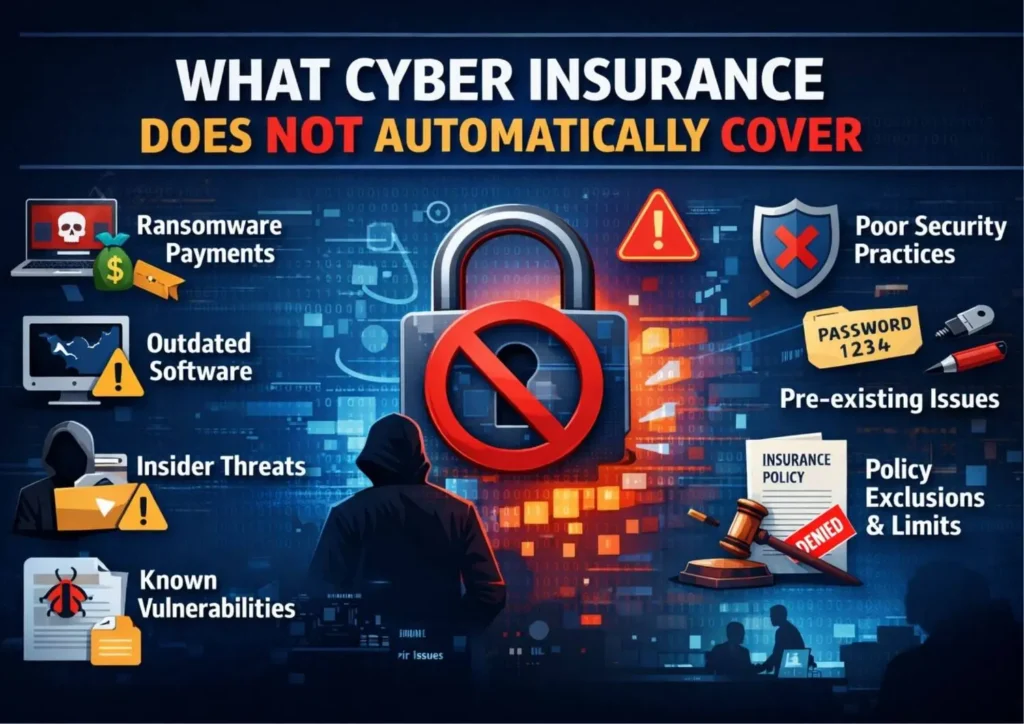
Many business owners misunderstand how cyber insurance really works. It does not protect against every cyber problem automatically. If a company ignores basic security steps like updating software, using strong passwords, keeping backups, or training staff, the insurance company may reduce the claim amount or deny it completely. Cyber insurance is meant to help when something unexpected happens, not when simple safety rules are ignored.
Most cyber liability insurance policies also come with clear limits and exclusions. Not every ransomware payment is covered, especially if basic security measures were missing. Losses caused by old or unsupported software are often excluded. Damage caused by employees may not be covered if proper controls were not in place. Issues that were already known before the policy was purchased are usually excluded as well. For this reason, Cyber insurance does not excuse poor security practices. If a company ignores basic safeguards, insurers may deny or limit claims.
Also, not every policy covers:
- All ransomware payments
- Losses from outdated software
- Insider threats without safeguards
- Prior known vulnerabilities
I always tell clients: cyber insurance is a safety net, not a replacement for cyber hygiene.
How Cyber Security Insurance Pricing Really Works
Company Size and Revenue
Larger businesses usually pay more, but smaller companies often pay higher rates relative to size because they’re seen as easier targets.
Industry Type
Healthcare, finance, legal, and e-commerce typically face higher premiums due to sensitive data exposure.
Security Practices
Insurers now ask detailed questions:
- Do you use multi-factor authentication?
- Are backups encrypted and tested?
- Is employee training documented?
Better answers usually mean lower premiums.
Coverage Limits and Deductibles
A $1 million policy with low deductibles costs more than a $250,000 policy with higher retention.
As a rough example, I’ve seen small US businesses pay anywhere from $700 to $3,500 annually, depending on risk profile and coverage depth.
Cost Comparison of Cyber Security Insurance Coverage in the USA
The cost of cyber security insurance coverage depends on several key factors. These include business revenue, the type of industry, how much data the company handles, and how strong its security systems are. Actual premiums may be higher or lower, but these ranges reflect common pricing patterns seen in the market.
| Business Size | Annual Revenue | Coverage Limit | Estimated Annual Cost (USD) |
| Small Business | Up to $5M | $1M | $750 – $1,500 |
| Growing Business | $5M – $25M | $2M – $5M | $2,000 – $5,000 |
| Mid-Sized Enterprise | $25M – $100M | $5M – $10M | $6,000 – $15,000 |
| Large Enterprise | $100M+ | $10M+ | $20,000 – $50,000+ |
Note:- The chart shows estimated price ranges for businesses in the USA.
Data Breach Insurance Response and Notification Support
Data breach Insurance response has become highly structured due to regulatory expectations. Notification requirements vary by jurisdiction and can involve strict timelines. Failure to comply often results in additional penalties.
Cyber security insurance coverage typically provides access to breach response specialists. These professionals assist with legal guidance, customer notification, and coordination with regulators. Their involvement reduces confusion during a stressful period and helps ensure compliance.
The cost of notification, credit monitoring, and public communication can exceed technical repair expenses. Insurance coverage absorbs these costs while preserving customer trust.
Common Cyber Insurance Mistakes Businesses Regret Later
Over the years, the same cyber insurance mistakes keep showing up again and again. Many businesses focus only on low cost and end up choosing policies that look good on paper but fail during real cyber claims. Others misjudge how much money they would lose if systems go down, or wrongly assume their existing insurance already covers cyber risks. These mistakes usually become clear only after a serious incident happens, when it is too late to fix them.
Common mistakes include
- Choosing the cheapest policy without checking exclusions
- Insuring business income for less than the real loss
- Assuming general liability covers cyber incidents
- Ignoring policy updates as the business grows
One major issue with cyber insurance for small businesses is not reviewing the policy regularly. As a small business grows, it may add new systems, handle more customer data, or expand its operations. A policy that was enough a few years ago might no longer provide full protection. Without updates, even small businesses with insurance can be at risk if a cyberattack occurs.
How to Choose the Best Cyber Security Insurance Coverage
1. Understand Your Real Risk
Start by identifying what data your business stores, how your systems work, and what could happen if they go down. Knowing the true impact of downtime or a breach helps you choose coverage that actually protects your business from real losses.
2. Review Existing Policies
Check any current insurance policies to see if they already include cyber-related protection. Identify gaps or limits in coverage so you know what additional protection is needed. This ensures you are not paying for what you already have and avoids surprises during a claim.
3. Compare Coverage, Not Just Price
Do not focus only on the premium cost. Look at what each policy actually covers, including ransomware response, business interruption waiting periods, and incident response support. Choosing the right coverage is more important than saving a few dollars upfront.
4. Ask Claims-Based Questions
When talking to insurers, ask how claims are handled in real situations, not just what the policy promises. Understanding the process, timing, and potential hurdles helps you pick a provider that will support you effectively during an actual cyber incident.
5. Revisit Annually
Cyber risks change quickly as technology and threats evolve. Review and update your policy at least once a year to ensure coverage keeps pace with your growing business and new risks. Regular updates help avoid gaps that could leave your business exposed.
Advantages of Cyber Security Insurance Coverage
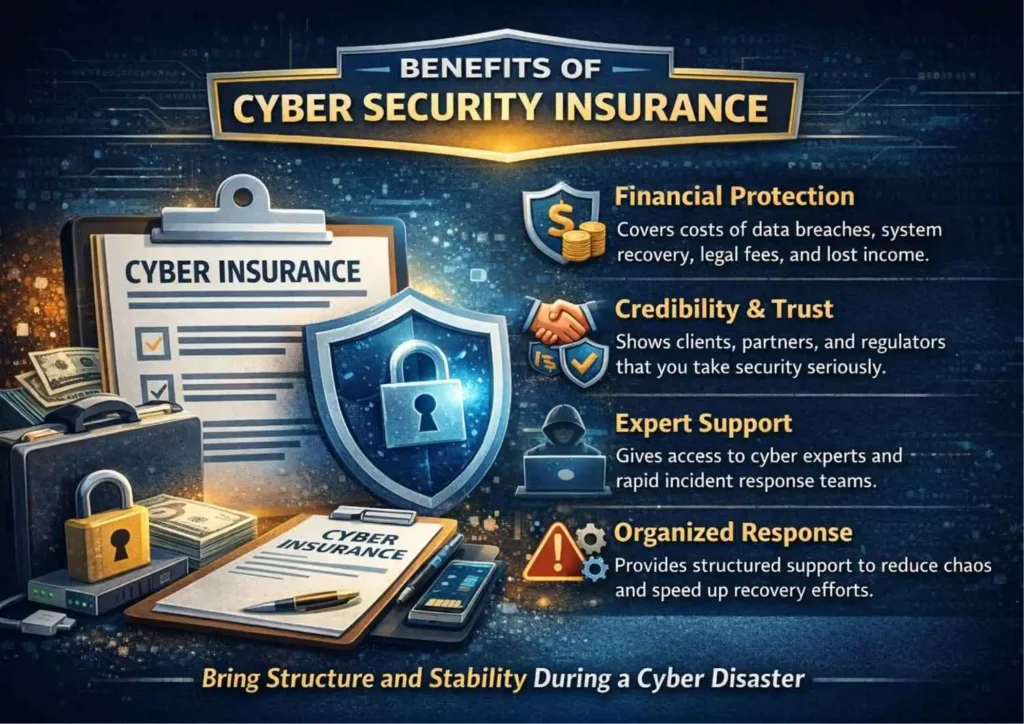
The biggest advantage of cyber security insurance is financial protection. If a cyberattack or data breach happens, the insurance helps cover costs like system recovery, legal fees, and lost income. This support can be the difference between a business surviving or shutting down after a serious cyber event.
Another benefit is credibility. Having cyber insurance shows clients, partners, and regulators that your business takes security seriously. It builds trust and confidence, which can strengthen relationships and even help win new contracts.
Other key advantages include:
- Access to cyber experts and incident response teams
- Structured support during emergencies
- Reduced stress and faster recovery when a breach occurs
Overall, cyber security insurance brings structure to chaos. When something goes wrong, you have guidance and financial support in place, so you don’t have to start from scratch. This makes recovery faster, more organized, and less damaging to your business reputation.
Regulatory Expectations and Compliance Pressure
Regulators expect businesses to take reasonable steps to keep customer and employee data safe. If a business fails to do this, it can face fines or other legal actions. Cyber security insurance can help by covering some of these regulatory costs and giving expert advice during investigations.
Insurance does not excuse careless behavior, but it can reduce the financial damage when problems happen even though proper safety steps were taken. With the right coverage, businesses can respond faster, handle investigations better, and protect their money and reputation.
This makes cyber security insurance not just a way to pay for losses, but also a helpful tool for following rules and showing clients, partners, and regulators that the business takes security seriously.
How Insurance Centrik Supports Against Cyber Security Risks
Insurance Centrik is often mentioned when people talk about how businesses can prepare for cyber risks from a financial point of view. We provide only information not selling products, but on explaining why cyber security insurance coverage should match how a business actually works. Every company uses technology in a different way. Some handle customer data daily, while others depend heavily on online systems to run operations. Looking at these differences helps show how insurance can respond to real problems such as data breaches, ransomware attacks, system shutdowns, or legal claims from outside parties.
We also present cyber insurance as something that should be reviewed over time, not chosen once and forgotten. Cyber threats change, and business systems change too. Clear explanations of policy terms and regular reviews help companies stay aware of where they stand. When a cyber incident happens, properly aligned cyber security insurance coverage can reduce financial pressure, support recovery costs, and help keep the business running, so owners and teams can focus on fixing operations instead of worrying about sudden losses.
Cyber Security Insurance and Business Stability
Cyber risk is now a fundamental business exposure. Ignoring it places financial stability, reputation, and growth at risk. Cyber security insurance coverage provides a structured way to absorb the financial shock of digital incidents while supporting recovery and continuity.
The strongest protection comes from pairing robust internal security with well-designed insurance coverage. Together, they form a resilient foundation that allows businesses to operate confidently in an increasingly digital economy.
For businesses preparing for 2026, the focus should not be on whether cyber insurance is necessary, but on how effectively it reflects real-world risk and operational dependency.
FAQs
Does cyber security insurance cover employee mistakes?
Many policies cover certain employee errors, like accidental data leaks, but coverage depends on proper training and security practices being followed.
Is ransomware always covered?
Not always, coverage depends on policy details, legal rules, and whether proper security measures and backups were in place.
Can small startups afford cyber insurance?
Yes, small startups and businesses can select lower coverage limits with affordable premiums, making cyber insurance a realistic option to protect against data breaches, ransomware, and other digital threats.
Is cyber insurance required by law in the USA?
Generally no. Federal law does not require it, but contracts, regulations, or client expectations may effectively make it necessary.