

The average funeral in the United States now costs between $8,000 and $12,000 — and most American families have less than $5,000 saved to cover it. For seniors living on a fixed retirement income, this gap can leave loved ones scrambling to pay bills during an already devastating time.
Final expense insurance for seniors is a type of life insurance designed to cover costs that arise after a person passes away. These costs usually include funeral services, burial or cremation expenses, medical bills left behind, legal paperwork, and small personal debts. The main goal is to reduce the financial burden on family members during an emotional time.
Unlike traditional life insurance, this coverage focuses on smaller benefit amounts and easier approval. It is built for seniors who want peace of mind without complex policies or high premiums. Most plans stay active for life as long as premiums are paid, and the payout goes directly to the beneficiary chosen by the policyholder.
This insurance is especially popular among older adults in the USA who want to plan ahead, keep control over their final wishes, and avoid leaving sudden expenses to loved ones.
Why Final Expense Insurance Matters for Seniors
When final life costs are higher than expected, even a simple funeral can cause stress for families dealing with loss. Final expense insurance for seniors provides affordable help to cover funeral, burial, and related expenses.
Funeral and related expenses often include:
- Funeral home services
- Casket or urn
- Burial plot or cremation fees
- Transportation of the body
- Headstone or memorial
- Clergy or officiant fees
- Outstanding medical or hospice bills
Many families are forced to use savings, credit cards, or fundraising to cover these costs. According to the National Funeral Directors Association (NFDA), the median cost of a funeral with burial in the United States reached $8,300 in 2023 — and that figure continues to rise annually. Planning ahead with final expense coverage ensures dignity, clarity, and financial relief.
How Final Expense Insurance for Seniors Works
Final expense insurance for seniors is designed to be simple and easy to understand. A senior applies for a policy, chooses a coverage amount, names a beneficiary, and pays a fixed premium. When the policyholder passes away, the insurance company pays the death benefit directly to the beneficiary.
Unlike term life insurance, final expense insurance is a form of whole life insurance, meaning the coverage lasts for life as long as premiums are paid. Whole life insurance rates for seniors are generally based on factors such as age, health, gender, and the amount of coverage selected. Since final expense policies typically offer smaller coverage amounts, they are often more affordable than traditional whole life insurance.
Key features include:
- Coverage amounts usually range from $2,000 to $50,000
- Premiums remain the same for life
- Policies do not expire as long as payments continue
- Payouts are generally tax-free for beneficiaries
Because the coverage amount is smaller than traditional life insurance, approval is often faster and easier. Many plans do not require a medical exam, making them a practical option for seniors with existing health conditions.
Types of Final Expense Insurance for Seniors
There are three main types available in the USA. Each fits different health and budget situations.
1. Simplified Issue Final Expense Insurance
This option requires answering a few health questions but does not require a medical exam.
- Faster approval
- Lower premiums than guaranteed options
- Immediate full coverage in most cases
This type works well for seniors in relatively stable health.
2. Guaranteed Issue Final Expense Insurance
This option accepts almost everyone regardless of health.
- No health questions
- No medical exam
- Higher premiums
- Often includes a 2-year waiting period
If death occurs during the waiting period, the beneficiary usually receives a refund of premiums plus interest instead of the full benefit.
3. Graded Benefit Final Expense Insurance
This is a middle ground between simplified and guaranteed plans.
- Some health questions required
- Partial coverage in early years
- Full benefit after waiting period ends
This option suits seniors with moderate health issues who still want some level of coverage.
Top 5 Final Expense Insurance Companies for Seniors (2026)
In our review of over 20 insurance providers offering final expense plans in the United States, these five companies consistently offer the best combination of affordable premiums, reliable payouts, and easy approval for seniors.
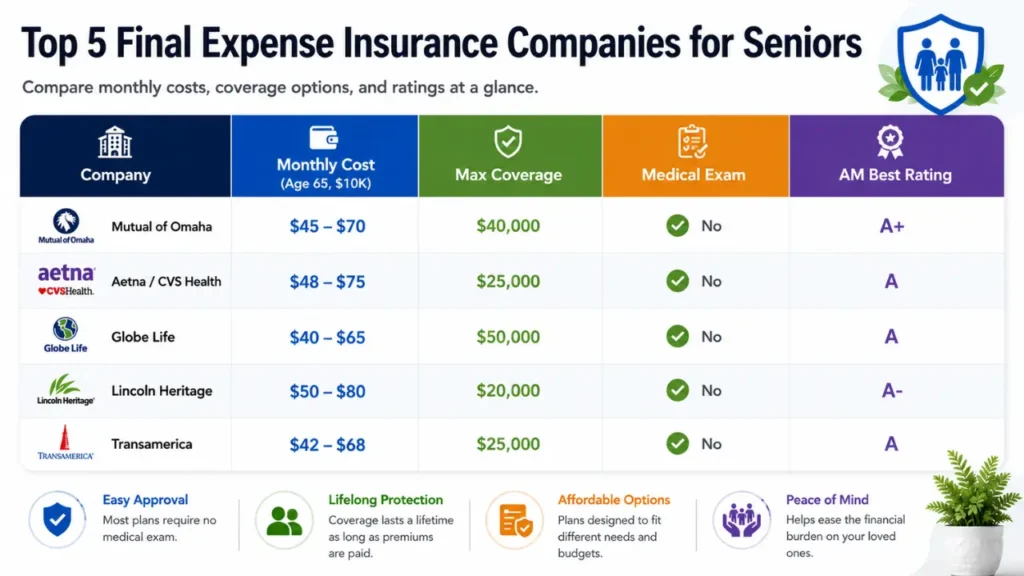
Estimated monthly premium for a healthy, non-smoking 65-year-old purchasing a $10,000 final expense policy.
1. Mutual of Omaha
Mutual of Omaha is consistently rated the top final expense insurer in the United States. Their Living Promise plan offers coverage from $2,000 to $40,000 with no medical exam required. Seniors aged 45 to 85 can apply, and approval is typically granted within minutes. Their A+ AM Best rating reflects outstanding financial stability — meaning claims will be paid reliably.
- Best for: Seniors aged 50-80 who want the most trusted brand
- Pros: A+ rating, fast approval, no medical exam, large coverage amounts
- Cons: Slightly higher premiums than budget options
- Insider tip: Their Level Benefit plan has no waiting period if you qualify through health questions
2. Globe Life
Globe Life is one of the most competitively priced final expense options available, with policies offering coverage up to $50,000 — the highest maximum on this list. Regular monthly premiums for younger applicants in good health typically start around $20 to $30 per month. Globe Life also accepts applicants up to age 80, and their simplified online application takes less than 10 minutes to complete.
- Best for: Budget-conscious seniors who want maximum coverage
- Pros: Very competitive rates, high coverage limit, easy online application
- Cons: Customer service ratings are mixed
- Insider tip: Apply online for instant approval — no agent required
3. Aetna / CVS Health
Aetna’s final expense plans are particularly well suited for seniors with pre-existing conditions like diabetes, COPD, or heart disease. Their Guaranteed Issue plan accepts every applicant with no health questions at all. Aetna’s nationwide network and strong claims process make them a reliable choice.
- Best for: Seniors with health conditions who have been declined elsewhere
- Pros: Guaranteed acceptance, trusted brand, nationwide availability
- Cons: 2-year waiting period on guaranteed issue plans
4. Lincoln Heritage
Lincoln Heritage is known for their Funeral Advantage program — a specialized final expense plan that comes with a family support service to help your loved ones navigate funeral arrangements. They have one of the fastest claims payout records in the industry, typically processing within 24 hours.
- Best for: Families who want fast claims processing
- Pros: 24-hour claims payout, funeral planning support service included
- Cons: Lower maximum coverage than competitors
5. Transamerica — Best for Younger Seniors (50-65)
Transamerica offers some of the most competitive rates for seniors in the 50 to 65 age range. Their Immediate Solution plan provides full coverage from day one with no waiting period for qualifying applicants. Coverage amounts go up to $25,000 and premiums are locked in permanently.
- Best for: Seniors aged 50-65 buying early for lowest rates
- Pros: Competitive rates for younger seniors, no waiting period option
- Cons: Limited to age 80 for new applicants
Who Should Consider Final Expense Insurance for Seniors?
Final expense insurance for seniors is ideal for individuals who want a clear and affordable solution for managing final life expenses without unnecessary complexity. Many seniors in the USA choose this type of coverage because it focuses on practical needs rather than large death benefits. It is especially helpful for those living on a fixed retirement income who want predictable premiums and lifelong protection.
Final expense insurance for seniors over 70 can be particularly valuable, as it offers an accessible way to help cover funeral, burial, and other end-of-life expenses when traditional life insurance may be more difficult to qualify for or more expensive.
It is especially suitable for:
- Seniors aged 50 to 85
- Seniors over 70 looking for simple, lifelong coverage
- Individuals without savings set aside for funeral costs
- People who do not qualify for traditional life insurance
- Those who want to leave money specifically for burial expenses
- Families who want clarity instead of uncertainty
It is not meant to replace large life insurance policies. Instead, it fills a specific and important gap by helping loved ones manage final expenses without added financial stress.
Benefits of Final Expense Insurance for Seniors
Final expense insurance for seniors provides emotional and financial relief at a time when families are most vulnerable. One of the biggest benefits is certainty. Seniors know their final expenses will not fall on loved ones. Premiums remain fixed for life, making budgeting easier even on a limited retirement income.
1. Financial Protection
Final expense insurance for seniors helps protect families from unexpected financial stress when a loved one passes away. Funeral and burial costs often need to be paid quickly, and this coverage provides immediate funds. It works as a financial cushion, allowing families to focus on emotional healing rather than worrying about sudden expenses or debt.
2. Fixed Premiums for Life
One major advantage is premium stability. Once the policy starts, the monthly payment remains the same for life. Premiums do not increase due to aging or health changes, which helps seniors manage their retirement budget without fear of rising insurance costs.
3. Lifetime Coverage
Final expense insurance provides lifelong protection. The policy remains active as long as premiums are paid on time. There is no expiration date, and coverage does not end due to age. This ensures that the benefit will be available whenever it is needed.
4. Easy Approval — No Medical Exam Required
Most final expense insurance plans are designed for simple approval. Many do not require medical exams, and health questions are minimal. This makes coverage accessible for seniors with existing health conditions who may not qualify for traditional life insurance policies.
Cost of Final Expense Insurance for Seniors — 2026 Rates
The cost depends on several factors including age, gender, health, coverage amount, and policy type. Based on our analysis of current market rates across major insurers, here are realistic premium estimates for a $10,000 policy:
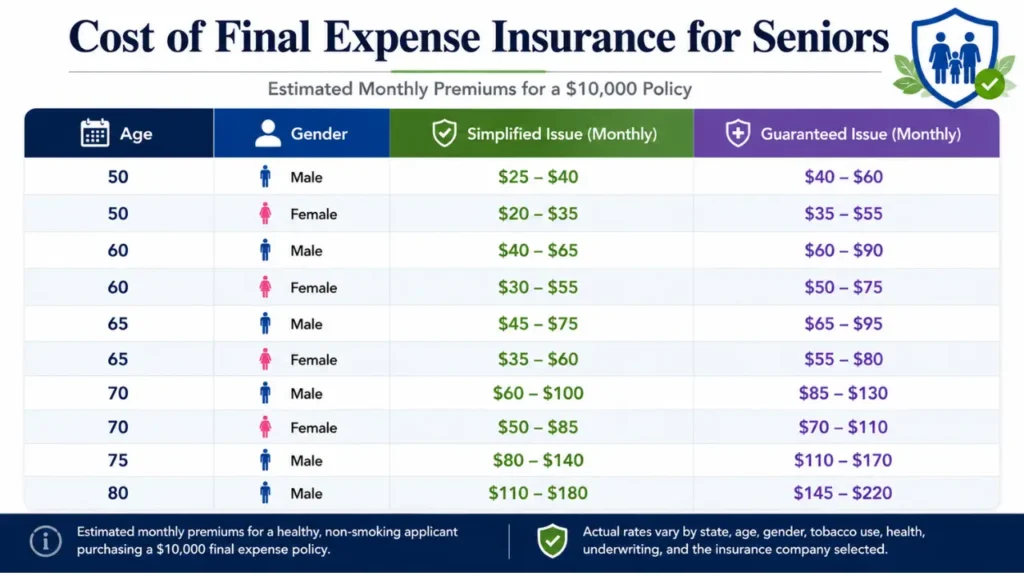
Important: These are market estimates. Your exact premium depends on your health history, state of residence, and the specific plan selected. Always get a personalized quote directly from the insurer.
State-Wise Average Funeral Costs in the USA — How Much Coverage Do You Need?
One of the most important questions seniors ask is: how much final expense coverage do I actually need? The answer depends heavily on where you live. Funeral costs vary significantly by state, and buying too little coverage means your family will still face out-of-pocket costs.
| State | Avg. Funeral Cost (Burial) | Avg. Cremation Cost | Recommended Coverage |
| California | $10,000 – $14,000 | $3,500 – $5,500 | $12,000 – $15,000 |
| New York | $8,000 – $15,000 | $4,000 – $6,000 | $15,000 – $20,000 |
| Florida | $9,000 – $12,500 | $3,000 – $5,000 | $10,000 – $12,000 |
| Texas | $8,000 – $11,000 | $2,500 – $4,500 | $10,000 |
| Georgia | $7,500 – $10,000 | $2,000 – $4,000 | $8,000 – $10,000 |
| Illinois | $9,000 – $12,000 | $3,000 – $5,000 | $10,000 – $12,000 |
| Ohio | $7,000 – $9,500 | $2,000 – $3,500 | $8,000 – $10,000 |
| Pennsylvania | $9,500 – $13,000 | $3,200 – $5,200 | $10,000 – $13,000 |
| North Carolina | $7,500 – $10,500 | $2,500 – $4,000 | $8,000 – $10,000 |
| Arizona | $8,500 – $11,500 | $2,800 – $4,800 | $10,000 – $12,000 |
The figures shown are estimated 2026 funeral costs derived from industry reports and regional pricing trends. Actual expenses may differ depending on your location, funeral provider, and service preferences. Compare funeral homes in your state.
What Does Final Expense Insurance Cover?
Final expense insurance for seniors provides flexible coverage designed to handle real end-of-life costs in the USA. The benefit amount is paid in cash to the chosen beneficiary and can be used as needed. Unlike prepaid funeral plans, there are no restrictions on how the money must be spent.
Coverage commonly includes:
- Funeral and memorial services
- Burial plot, casket, or cremation costs
- Medical or hospice bills
- Legal and administrative fees
- Outstanding personal expenses and small debts
This flexibility allows families to manage expenses according to their actual needs while honoring the senior’s final wishes without financial pressure.
Final Expense Insurance vs Other Options
Final Expense Insurance vs Traditional Life Insurance
| Feature | Final Expense Insurance | Traditional Life Insurance |
| Coverage Amount | $2,000 – $50,000 | $100,000+ |
| Medical Exam | Usually Not Required | Often Required |
| Approval Time | Minutes to Days | Weeks |
| Premium Stability | Fixed for Life | May Vary |
| Age Limit for Applying | Up to 85 | Usually up to 70-75 |
| Primary Purpose | Funeral & final costs | Income replacement |
| Waiting Period | Sometimes (2 years) | Rarely |
Final Expense Insurance vs Prepaid Funeral Plans
Final expense insurance provides flexibility that prepaid funeral plans often lack. Instead of locking money into specific services or providers, insurance pays cash directly to beneficiaries. Families can choose arrangements freely and adjust plans based on current needs.
- Cash benefit with no spending restrictions
- Freedom to choose any funeral provider
- Coverage can handle costs beyond just the funeral
- No risk of funeral home going out of business
Final Expense Insurance vs Savings Accounts
Unlike savings accounts, insurance benefits are paid quickly and are not affected by market changes or spending habits. A savings account can be depleted by medical bills or daily expenses. Insurance ensures money is reserved specifically for final expenses.
- Funds protected and reserved — cannot be accidentally spent
- Quick payout without probate delays
- Benefit amount often exceeds total premiums paid
When Is the Best Age to Buy Final Expense Insurance?
The earlier you buy, the lower your premium — permanently. This is one of the most important decisions seniors make because premiums are locked in at the age you apply and never increase. Here is a simple guide by age group:
Ages 50 to 60 — Best Time to Buy
This is the sweet spot for final expense insurance. Health is typically still good enough to qualify for simplified issue plans with no waiting period, and premiums are at their lowest. A 55-year-old woman can get $15,000 of coverage for as little as $30 to $45 per month. Waiting until age 65 for the same coverage could cost $55 to $80 per month — the same protection but 40% more expensive.
Ages 60 to 70 — Still Excellent Time, Act Soon
Most major insurers still offer simplified issue plans with immediate coverage for this age group. Premiums are moderate and coverage options are still broad. If you have developed any health conditions in recent years, this is the time to act before options narrow further.
Ages 70 to 85 — Options Still Available
Coverage is still available for seniors in this age group, but options narrow and premiums increase significantly after age 75. Guaranteed issue plans — which accept everyone regardless of health — are the most common choice in this group. Expect to pay $80 to $160 per month for a $10,000 policy and be aware of the 2-year waiting period on most guaranteed issue plans.
Common Myths About Final Expense Insurance for Seniors
There are several misunderstandings that prevent people from considering this valuable option:
- Myth: It is only for people with serious illness — Fact: Anyone aged 50-85 can apply, healthy or not
- Myth: It is too expensive — Fact: Plans start from as little as $20/month for younger seniors
- Myth: The money can only be used for the funeral — Fact: Beneficiaries can use the cash for any expense
- Myth: It replaces Medicare or health insurance — Fact: It is completely separate from health coverage
- Myth: Seniors over 75 cannot get coverage — Fact: Guaranteed issue plans accept applicants up to age 85
How to File a Final Expense Insurance Claim — Step by Step
Filing a final expense insurance claim is usually simple. Once the claim is approved, beneficiaries often receive the death benefit within 24 to 72 hours, although timelines may vary by insurer.
Follow these steps:
- Notify the insurance company as soon as possible.
- Submit a certified death certificate and complete the claim form.
- Verify your identity as the named beneficiary.
- Choose your payment method, such as direct deposit or check.
- Receive the payout, typically within 24–72 hours for straightforward claims.
- Use the funds as needed, including funeral, burial, medical, or other expenses.
Note: Life insurance death benefits are generally federal income tax-free for beneficiaries. If you have questions about a claim, contact your insurance company or your state’s insurance department.
Steps to Take Before Applying for Final Expense Insurance
Choosing the right final expense insurance policy starts with careful planning. Taking a few simple steps before you apply can help you find affordable coverage, avoid unexpected costs, and ensure your loved ones receive the financial protection they need.
1. Review Your Monthly Budget
Choose a premium you can comfortably afford for the rest of your life. Since final expense insurance is designed to provide lifelong coverage, missing payments could cause your policy to lapse.
2. Estimate Your Coverage Needs
Calculate how much coverage you’ll need based on expected funeral, burial, cremation, medical bills, and other end-of-life expenses. Use the state-by-state funeral cost estimates above as a helpful starting point.
3. Choose the Right Policy Type
Decide whether a Simplified Issue or Guaranteed Issue policy best fits your situation. If you have serious health conditions or expect difficulty qualifying for traditional coverage, a guaranteed issue policy may be the better option because it does not require medical underwriting.
4. Compare Quotes From Multiple Insurance Companies
Don’t settle for the first quote you receive. Compare at least three reputable insurers, as premiums for similar coverage can vary by 20% to 40%, depending on your age, health, and state of residence.
5. Understand the Waiting Period
Review the policy’s waiting period carefully. Some guaranteed issue plans include a two-year graded death benefit, meaning beneficiaries may receive limited benefits if the insured passes away during the initial waiting period.
6. Verify Your Beneficiary Information
Double-check that your beneficiary’s full name, relationship, and contact information are accurate. Keeping this information up to date helps prevent delays during the claims process.
7. Ask About the Free-Look Period
Most states require insurers to provide a free-look period, typically lasting 10 to 30 days, during which you can review the policy and cancel for a full refund if it doesn’t meet your needs. Always confirm the exact free-look period available in your state.
Planning Ahead Protects the People You Love
Planning ahead with final expense insurance is one of the most meaningful ways to protect your family from unexpected financial stress. With fixed premiums, lifelong coverage, and tax-free benefits for most beneficiaries, these policies help ensure funeral and other end-of-life expenses are covered without placing a burden on loved ones.
Whether you’re purchasing coverage for yourself or helping a family member explore options, taking the time to compare plans, understand policy features, and choose a financially strong insurer can make all the difference. The earlier you apply, the more likely you are to lock in a lower premium for life.
Our Top Recommendations
| Category | Recommended Company | Why We Recommend It |
| Best Overall | Mutual of Omaha | A+ AM Best rating, competitive premiums, and no medical exam for many applicants. |
| Best Value | Globe Life | Affordable coverage options with benefits up to $50,000. |
| Best for Health Concerns | Aetna | Guaranteed issue options available for eligible applicants. |
| Best Claims Support | Lincoln Heritage | Well-known for dedicated final expense service and responsive claims assistance. |
| Best for Ages 50–65 | Transamerica | Competitive rates for healthy applicants and flexible coverage options. |
Final Tip: Before buying a policy, compare quotes from multiple insurers, choose a coverage amount that reflects funeral costs in your state, and select a company with a strong financial strength rating. Applying earlier can help you secure a lower lifetime premium and provide lasting financial protection for the people who matter most.
FAQs
Is there a waiting period for final expense insurance?
It depends on the policy. Many simplified issue plans provide immediate coverage, while guaranteed issue policies typically have a two year waiting period before the full death benefit becomes available for natural causes.
Can I have more than one final expense insurance policy?
Yes. You can own more than one final expense insurance policy if you qualify. Many seniors purchase multiple policies to cover funeral expenses and leave additional financial support for their loved ones.
Is final expense insurance worth it for seniors over 80?
Yes. Final expense insurance can still be a good option for seniors over 80. Although premiums are usually higher, the coverage helps protect your family from unexpected funeral and other end of life expenses.
Can seniors with health problems get final expense insurance?
Yes. Many seniors with diabetes, high blood pressure, heart disease, COPD, or other health conditions can still qualify for final expense insurance. Depending on your health, you may be eligible for either a simplified issue policy or a guaranteed issue policy.

Aarvith is the author and founder of Insurance Centrik. He researches various insurance topics, including auto, health, travel, home, and business insurance. He provides accurate insurance information from reliable sources and industry expertise.