
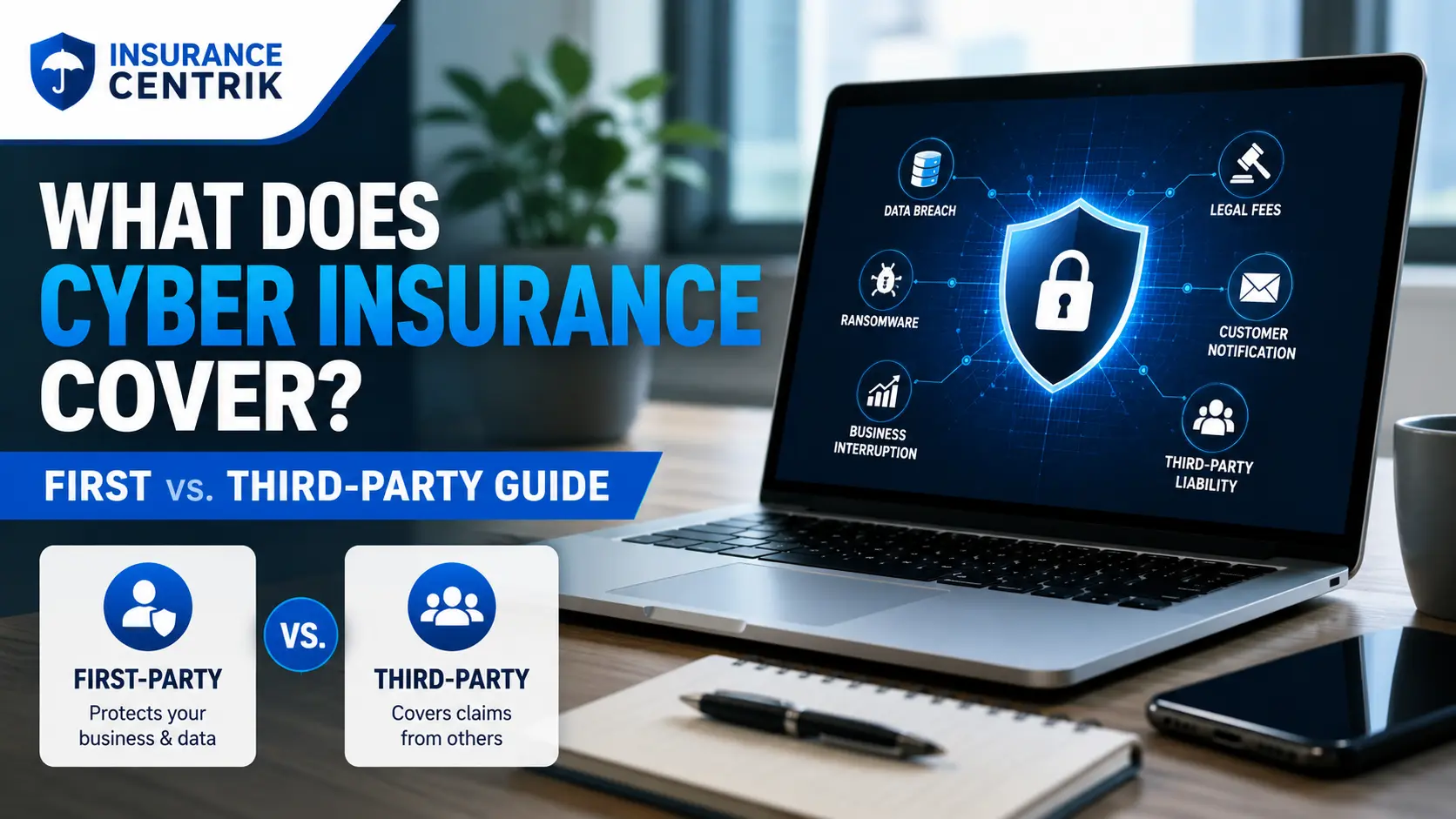
Cyber insurance covers two separate kinds of financial fallout from a cyberattack or data breach: the direct costs your own business absorbs (first-party coverage) and the claims other people bring against you because your systems failed to protect their information (third-party coverage). Most policies bundle both, but they respond to very different situations, and understanding the split is the fastest way to know whether a policy actually fits your business.
Key Takeaways
- First-party coverage pays for costs your business incurs directly, such as breach notification, business interruption, and ransomware negotiation.
- Third-party coverage pays for claims, lawsuits, and regulatory penalties brought by customers, vendors, or regulators after a breach traced back to you.
- Exclusions matter. Cyber policies commonly exclude pre-existing vulnerabilities, acts of war, and losses tied to unpatched systems.
- Sizing coverage should reflect your revenue, the sensitivity of the data you hold, and your realistic worst-case scenario, not a generic industry average.
What Is Cyber Insurance?
Cyber insurance is a business policy designed to absorb the financial shock of a digital incident: a ransomware attack, a phishing scam that drains a company bank account, a hacked customer database, or a vendor’s system failure that knocks your operations offline. It exists because general liability and property policies were written for physical risks and typically exclude anything that happens purely in digital form.
A cyber policy is really two policies stitched together. One half looks inward, at what the incident costs your own company. The other half looks outward, at what you owe to the people affected by it. Insurers separate these because the underwriting, the payout process, and the risk factors are genuinely different for each.
First-Party Cyber Coverage: Protecting Your Own Business
First-party coverage reimburses your company for the direct costs of responding to and recovering from an incident. This is money that flows to you, not to someone suing you. It typically includes:
- Breach notification costs — printing, mailing, and legal fees required to notify affected individuals under state data breach laws.
- Forensic investigation — hiring a digital forensics firm to determine how attackers got in and what they accessed.
- Business interruption — lost income and extra operating expenses while systems are down and you cannot process orders, bill clients, or run production.
- Ransomware response — negotiation with the attacker, the ransom payment itself where legally payable, and system restoration afterward.
- Data restoration — the cost of rebuilding or recovering corrupted or destroyed files and databases.
- Crisis communications — public relations support to manage customer trust and press inquiries after news of the breach spreads.
- Cybercrime and social engineering losses — funds stolen through fraudulent wire transfers or business email compromise, often sold as an add-on rather than baked into the base policy.
Because this coverage responds to what happens inside your own walls, insurers price it based on how much sensitive data you store, how mature your security controls are, and how long your business could survive an outage.
Third-Party Cyber Coverage: Protecting You From Others’ Claims
Third-party coverage responds when someone else — a customer, a business partner, a regulator — holds you financially responsible for a breach that exposed their information or disrupted their operations. It typically includes:
- Liability defense and settlements — legal costs and settlements from lawsuits filed by customers or clients whose data was compromised.
- Regulatory fines and penalties — costs tied to investigations and fines under state privacy laws, where insurable, along with the legal work to respond to regulators.
- Media liability — claims of copyright infringement, defamation, or privacy violations tied to your company’s online content or advertising.
- Payment Card Industry (PCI) fines — assessments from card networks and banks after a payment data breach.
- Vendor and contractual liability — costs when a client claims your negligence caused a breach on their end, common for IT consultants, SaaS providers, and payment processors.
This half of the policy is priced around how much third-party data you handle on behalf of others and how exposed you are contractually — a company that processes client payments or hosts client data carries more third-party risk than one that only manages its own internal records.
First-Party vs Third-Party Cyber Coverage: Side-by-Side
| Question | First-Party Coverage | Third-Party Coverage |
| Who receives the payout? | Your business | Affected customers, partners, or regulators, through you |
| What triggers it? | A breach or attack on your own systems | A claim or lawsuit alleging you caused someone else’s loss |
| Typical costs covered | Notification, forensics, downtime, ransomware, data recovery | Legal defense, settlements, regulatory fines, PCI assessments |
| Who tends to need more of it? | Companies with high downtime cost or large internal data stores | Companies handling client data, payments, or contractual work |
What Cyber Insurance Does Not Cover
No cyber policy covers every scenario, and reading the exclusions section matters as much as reading the coverage grants. Common cyber insurance exclusions include:
- Prior known incidents — a vulnerability or breach the company already knew about before the policy started.
- Failure to maintain agreed security standards — many policies require baseline controls such as multi-factor authentication; skipping them can void a claim.
- Acts of war and state-sponsored attacks — several major insurers now carve out nation-state cyberattacks, a clause that drew wide attention after large-scale malware incidents were linked to state actors.
- Bodily injury and physical property damage — these stay with general liability or property policies, even when a cyber incident indirectly triggers them.
- Intellectual property disputes unrelated to a breach — routine IP litigation isn’t a cyber claim just because it involves technology.
- Improvement in security infrastructure — insurers pay to respond to an incident, not to upgrade your systems beyond what existed before.
- Reputational loss without a quantifiable financial trigger — lost future business that can’t be tied to a covered event is typically not payable.
Reading a policy’s exclusions alongside its insuring agreements gives a far more accurate picture than the marketing summary ever will.
How Much Coverage Does Your Business Actually Need?
Cyber insurance is a “your money, your life” decision — the limit you choose determines what you can actually absorb if the worst happens, so it deserves the same care as choosing a health or disability policy. A practical way to size it:
- Add up your realistic worst-case exposure. Count the records you hold, the average notification cost per record in your state, and how many days of downtime a serious incident would cause.
- Match your limit to your revenue and data sensitivity. Businesses handling healthcare, financial, or large volumes of personal data generally need higher limits than a company holding minimal customer information.
- Separate first-party and third-party sub-limits. A single combined number can hide the fact that one side of your risk is underinsured; ask for the breakdown by category.
- Check your vendor contracts. Many client and payment-processing agreements specify a minimum cyber liability limit you’re contractually required to carry.
- Revisit the number annually. Data volume, headcount, and regulatory exposure change every year, and a limit that was adequate two years ago can fall short quickly. The cost of that limit will also shift with market conditions; it’s worth checking current cyber liability insurance pricing before renewal so the budget and the coverage stay aligned.
Businesses operating in stricter regulatory states carry their own cost dynamics, too — a California-based company, for instance, faces state-specific notification and privacy requirements that shape cyber insurance costs in California differently than a business elsewhere.
A Real-World Example: How a Claim Plays Out
Picture a mid-sized healthcare billing company that suffers a ransomware attack. Attackers encrypt the client database and demand payment to restore access.
- First-party response: the insurer’s panel forensics firm investigates the intrusion, a negotiator works with the attacker, the ransom is paid where permitted, systems are restored, and the company’s income during the four days of downtime is reimbursed.
- Third-party response: three months later, a group of patients whose records were exposed files a lawsuit alleging the company failed to secure protected health information. The insurer’s legal panel defends the claim, and a settlement is eventually reached with affected patients.
Without a policy covering both sides, the company would have paid the ransom, the downtime losses, the legal defense, and the settlement entirely out of pocket — a combination that has forced smaller companies to shut down entirely.
Endorsements Worth Adding to a Base Policy
Standard cyber policies rarely cover every scenario a modern business faces, which is why several endorsements are worth discussing with an underwriter rather than assuming they’re included:
- Social engineering and funds transfer fraud — covers money wired to a fraudster after a convincing impersonation email, a loss many base policies exclude or cap tightly.
- Contingent business interruption — pays for downtime caused by a vendor’s or cloud provider’s outage rather than your own systems, relevant for any business dependent on a third-party platform.
- Reputational harm coverage — a narrower version of PR support that extends to lost future revenue tied directly to a documented drop in customer trust after a publicized breach.
- Bricking coverage — reimburses the cost of replacing hardware that has to be physically replaced because malware made it permanently unusable.
- Dependent business interruption for supply chain partners — increasingly relevant as more breaches originate through a shared software vendor rather than a direct attack.
None of these are automatic. A policy quoted at a low premium often looks that way because several of these endorsements were left out, so comparing quotes on price alone can be misleading.
Why the Line Between First-Party and Third-Party Gets Blurry
In practice, a single incident often triggers both halves of a policy at once, which is part of why the distinction confuses business owners. A hacked customer database is a first-party event the moment it happens — the company must investigate, notify, and restore systems — and becomes a third-party event the moment an affected customer files a claim or a regulator opens an inquiry. The same breach, two different coverage triggers, two different claims processes running in parallel. This is also why bundled policies tend to serve most businesses better than buying either half separately: incidents rarely stay contained to one side of the ledger for long.
Choosing Cyber Insurance with Confidence
Cyber risk sits at the intersection of technology and everyday business operations, which is exactly why first-party and third-party coverage need to be evaluated together rather than assumed to overlap. Reviewing both halves of a policy, alongside its exclusions, is the difference between a policy that looks adequate on paper and one that actually holds up when a claim is filed — and that kind of side-by-side review is where working with Insurance Centrik tends to save business owners the most time and guesswork.
FAQs
Is cyber insurance the same as data breach insurance?
Data breach coverage is usually one component within a broader cyber policy, focused specifically on notification and credit monitoring costs, while full cyber insurance also covers business interruption, third-party liability, and cybercrime losses.
Does general liability insurance cover cyberattacks?
No. Standard general liability policies are written for bodily injury and property damage and almost always exclude purely digital losses, which is why a separate cyber policy exists.
Who needs third-party cyber coverage the most?
Businesses that store or process client data on someone else's behalf — IT consultants, payment processors, healthcare billing firms, SaaS providers — carry the highest third-party exposure because a breach on their end creates liability for their clients too.
Can a small business get cyber insurance affordably?
Yes. Small businesses with modest data volumes and strong basic controls, such as multi-factor authentication and regular backups, typically qualify for lower premiums than larger companies handling sensitive records at scale.

Bipin is a Senior Insurance Researcher and Content Strategist at Insurance Centrik with 8+ years of industry experience. He covers auto, health, home, life, travel, business, and dental insurance, helping readers make informed, confident coverage decisions.