
A check engine light can sometimes lead to a repair bill of several thousand dollars, especially if the mechanic recommends rebuilding or replacing the engine. At that point, many drivers want to know: does car insurance cover engine failure, or is the repair an out-of-pocket expense?
The honest answer is: it depends entirely on what caused the engine to fail. Insurance companies don’t look at the dollar amount on the repair estimate. They look at the event behind it. A blown engine from a flash flood and a blown engine from 150,000 miles of normal driving can look identical on a repair shop’s invoice, but they’re treated completely differently by an insurer.
Standard auto insurance was never built to be a maintenance plan. It was built to respond to specific, sudden events: collisions, fires, floods, vandalism. If your engine failure traces back to one of those, you may have a legitimate claim. If it traces back to age, wear, or a skipped oil change, you’re likely on your own, at least as far as your regular policy is concerned.
The One Question That Decides Everything: What Caused It?
Before anything else, figure out the cause. That single fact determines which part of your policy might apply, if any.
A hard front-end collision that cracks the radiator, drains the coolant, and cooks the engine as a result? That’s a different animal from an engine that starts knocking on a random Tuesday drive with no accident in sight. The first might fall under your collision coverage. The second almost certainly won’t.
Here’s how it generally breaks down:
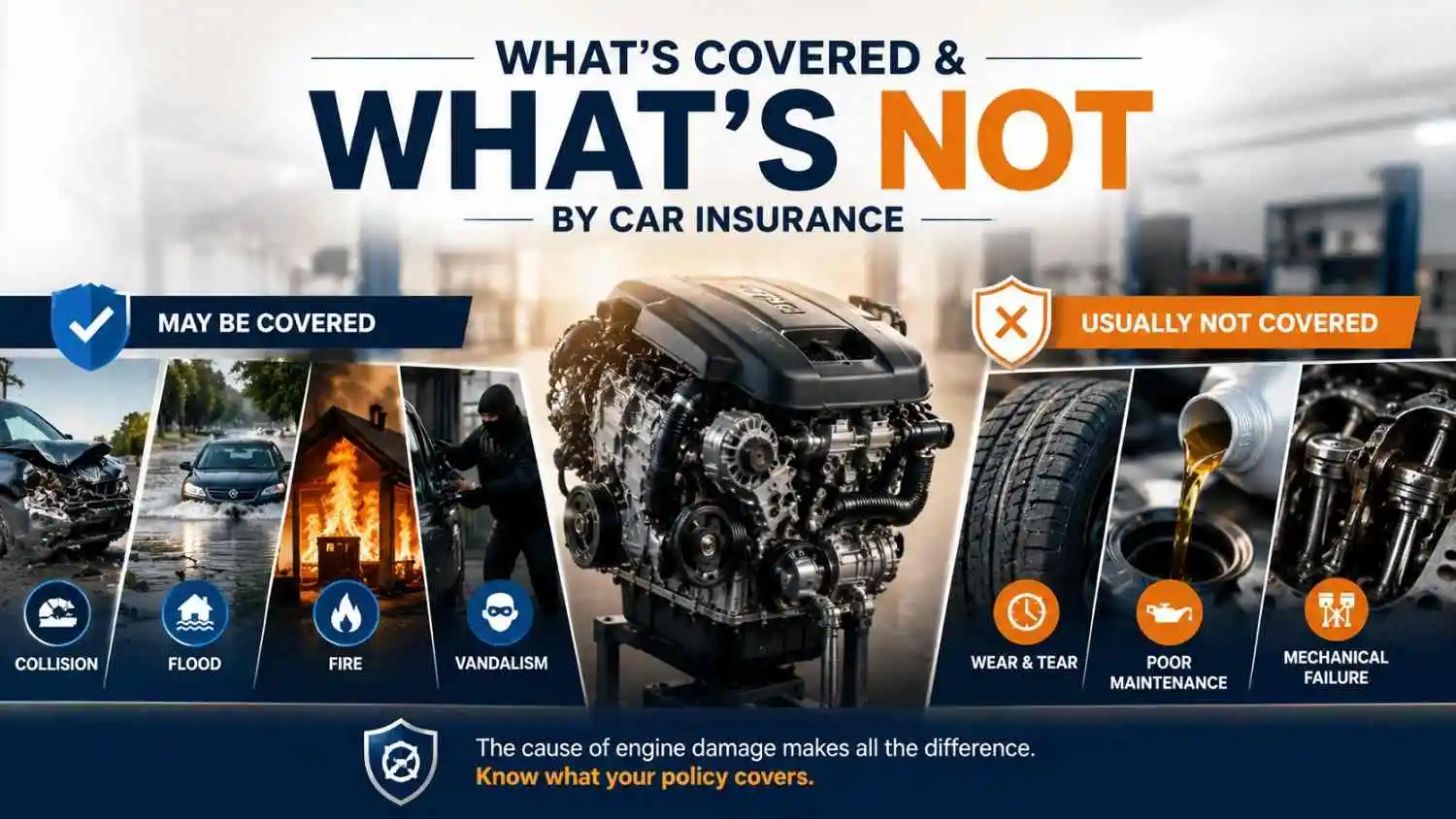
- Collision damages the engine – Collision coverage may apply
- Flood damages the engine – Comprehensive coverage may apply
- Fire damages engine components – Comprehensive coverage may apply
- Vandalism damages the engine – Comprehensive coverage may apply
- The engine simply wears out over time – Standard insurance usually won’t help
- Poor maintenance leads to failure – Standard insurance usually won’t help
- An internal component just breaks on its own – This is where mechanical breakdown coverage or a warranty becomes relevant, not your car insurance
The NAIC (National Association of Insurance Commissioners) frames collision coverage as protection against physical damage from your car hitting another vehicle or object, while comprehensive coverage handles a broader set of non-collision events like fire, severe weather, vandalism, and theft. Neither one was designed with “the engine got old” in mind.
A Side-by-Side Look at What Usually Gets Covered
Two people can walk into the same repair shop with the exact same $5,000 engine bill and walk out with two completely different insurance outcomes. The difference isn’t the repair. It’s the story behind it.
| Cause of Engine Damage | Likely Covered by Standard Policy? | Coverage That Might Apply |
| Collision | Possibly | Collision |
| Flood | Possibly | Comprehensive |
| Fire | Possibly | Comprehensive |
| Vandalism | Possibly | Comprehensive |
| Theft-related damage | Possibly | Comprehensive |
| Falling object | Possibly | Comprehensive |
| Normal wear and tear | Usually not | N/A |
| Age-related failure | Usually not | N/A |
| Poor maintenance | Usually not | N/A |
| Insufficient oil | Usually not | Often maintenance-related |
| Internal mechanical failure | Usually not | MBI or warranty may apply |
Keep in mind this table is a general guide, not a promise. Your specific insurer will weigh the cause, your exact policy wording, exclusions, your deductible, and whatever their claims investigation turns up.
When an Accident Is the Real Cause

Yes, collision coverage can pay for engine damage, but only when the connection between the crash and the engine problem is clear.
Picture a hard impact that crushes the radiator. Coolant starts leaking, the engine overheats, and within minutes it’s damaged. The engine itself wasn’t struck directly, but the chain of events started with the accident, and that matters. This is exactly the kind of scenario where a good repair shop diagnosis becomes valuable. The mechanic essentially has to connect the dots for the insurer between “car got hit” and “engine failed.”
One thing to be careful of: an accident doesn’t erase pre-existing engine problems. If your engine was already struggling before the crash, an insurer isn’t going to treat old mechanical wear as new accident damage just because the timing lined up.
If the repair keeps your car in the shop for more than a day or two, transportation becomes its own headache. It’s worth reading up on what happens with a rental car after an accident if that’s a concern, since rental reimbursement coverage is a separate conversation from whether the engine repair itself gets paid for.
On the liability side, remember that your own property damage liability coverage is there to pay for damage you cause to other people’s property. It was never meant to fix your own car. If someone else caused the crash, their liability coverage might come into play depending on fault and your state’s rules.
Is Engine Damage Covered Under Comprehensive Insurance?
“Comprehensive” is one of those insurance words that sounds like it covers everything. It doesn’t.
Comprehensive coverage is built for physical damage that isn’t the result of a collision, think fire, severe weather, vandalism, floods, and theft, according to the NAIC. So if your car is parked during a flash flood and water works its way into the engine, that damage may fall under a comprehensive claim, assuming it fits your policy’s terms. Same logic applies to a garage fire or someone keying more than just your paint job.
What comprehensive won’t do is step in when an old radiator hose finally gives out during a normal commute. Both Progressive and GEICO draw a firm line between damage from a covered event and the ordinary mechanical breakdowns that come with an aging vehicle. The word “comprehensive” describes the range of non-collision events it protects against, not a blanket guarantee against every possible thing that can go wrong under the hood.
Why Ordinary Engine Failure Rarely Gets Paid Out
An engine runs hot, under pressure, with dozens of parts in constant motion. Over enough miles, something is going to wear down. That’s not a flaw in the car. It’s physics. But it’s also exactly why insurers treat it as your responsibility, not theirs.
Car insurance generally won’t step in for:
- normal wear and tear
- age-related deterioration
- internal mechanical breakdown
- neglected maintenance
- worn-out components
- low oil or coolant from skipped maintenance
- routine part replacement
Progressive is direct about this: they state that car insurance typically won’t pay to repair or replace an engine when the cause is mechanical failure or ordinary wear. And the size of the bill doesn’t change that. An engine replacement that costs $8,000 doesn’t magically become a covered claim just because it’s expensive. Insurers respond to cause, not to cost.
This is usually the point where a manufacturer warranty, a vehicle service contract, or mechanical breakdown insurance becomes the more relevant conversation.
Does “Full Coverage” Mean Your Engine Is Covered?
Not necessarily, and this is one of the most common misunderstandings people have about their policy.
“Full coverage” isn’t an official insurance product. It’s just shorthand people use for a policy that combines liability, collision, and comprehensive coverage. What actually gets paid for still comes down to the individual coverages, their limits, deductibles, and exclusions.
So if a covered collision damages your engine, collision coverage may apply. If a covered flood or fire does the damage, comprehensive might kick in. But an engine that dies of old age is still outside both of those, regardless of how “full” your coverage sounds.
Policies also aren’t identical everywhere. Someone shopping around for car insurance in California should compare more than just the monthly premium. Available coverages, deductible options, and state-specific requirements can all differ from what’s standard elsewhere in the country.
Before assuming you’re protected, actually pull up your declarations page. That’s the document that tells you what you’re really paying for.
What About Flood Damage Specifically?
Flooding is a good case study because it draws such a clean line between “mechanical failure” and “physical damage from an outside event.”
Floodwater doesn’t just get the exterior wet. It can reach electrical systems, contaminate fluids, and work its way into engine components. Depending on how deep the water got and how long it sat, you could be looking at anything from a costly repair to a full engine replacement. Comprehensive coverage typically includes flood damage, assuming your policy is active and the terms are met.
Compare that to an engine that overheats because a cooling system part quietly failed during a normal drive. Both cars end up not running. Only one of them likely has a comprehensive claim behind it.
One safety note: if your car has been sitting in significant floodwater, resist the urge to just try starting it once the water goes down. That can turn a bad situation into a much more expensive one. Document everything with photos, and follow your insurer’s instructions on next steps.
Low Oil: A Maintenance Problem, Not an Insurance One
Running an engine low on oil is one of the fastest ways to destroy it, and one of the least likely situations to result in a paid claim.
Oil exists to reduce friction between moving parts. If the level drops too low and the driver keeps going anyway, especially after warning lights appear, insurers are going to view the resulting damage as a maintenance failure rather than a covered loss.
There’s an exception worth knowing about, though. If a covered accident is what caused the oil loss in the first place (say, a collision cracks the oil pan and the engine seizes shortly after), that changes the picture, because now the oil loss traces back to a covered event.
This is another spot where a mechanic’s write-up matters more than people expect. An engine that no longer runs looks the same from the outside whether it died from neglect or from an accident. The diagnosis is what tells the real story, and maintenance records, oil change receipts, service history, can back that story up when the cause is in question.
What Engine Repairs Actually Cost
Numbers help put all of this in perspective. “Engine repair” can mean anything from swapping one gasket to dropping in an entirely new engine, so costs vary a lot.
| Type of Work | Estimated Cost | Source |
| Head gasket replacement | $2,543–$3,337 | RepairPal, July 2026 |
| Professional engine rebuild | $3,500–$6,000 | Kelley Blue Book |
| Remanufactured engine | $5,000–$9,000 | Kelley Blue Book |
| Third-party remanufactured install | $1,200–$1,500+ | Kelley Blue Book |
| Dealership engine replacement | ~$8,000 average | KBB citing Cox Automotive |
RepairPal’s nationwide figures, last updated in July 2026, put a typical head gasket job at $2,538 to $3,337, split roughly into labor and parts, before taxes or related repairs. That number moves depending on the car; a Honda Civic head gasket job, for instance, runs closer to $2,254–$3,068 according to the same source.
Kelley Blue Book pegs a professional engine rebuild around $3,500 to $6,000, with a full remanufactured engine landing between $5,000 and $9,000. Dealership replacements tend to run higher still, averaging close to $8,000 based on Cox Automotive data, and high-performance engines can push well past that.
These are estimates, not quotes. Your actual number depends on your car’s year, make, model, engine type, and local labor rates. Only your mechanic can give you something precise.
Could Your Insurer Just Total the Car Instead?
Sometimes, yes, and it’s worth knowing this before you get too far into the repair process.
If an older car is in a serious accident and the engine needs major work on top of body damage, the total repair bill can climb past what the car is actually worth. The NAIC points out that with older vehicles, this happens fairly often: accident repair costs exceed the vehicle’s pre-loss value, and at that point the insurer may total the car and pay out based on that value instead of fixing it.
That’s an important reality check. An $8,000 engine estimate doesn’t automatically turn into an $8,000 check from your insurer. First, the damage has to trace back to something covered. Then the insurer weighs the full repair cost against what the car was worth beforehand, and state rules around total-loss thresholds vary, so the exact process depends on where you’re insured.
How Your Deductible Fits In
Collision and comprehensive coverage almost always come with a deductible: the chunk of the bill you’re responsible for before insurance picks up the rest.
Say a covered accident causes $5,000 in engine damage and your collision deductible is $1,000. In a simplified scenario, that leaves $4,000 potentially payable, though the final number still depends on the insurer’s own damage assessment and the specifics of your policy.
Deductibles matter even more on smaller repairs. If a covered repair only costs slightly more than your deductible, the amount insurance actually contributes might be minimal, sometimes not worth filing a claim over at all, once you factor in how claims can affect future premiums. Your declarations page will spell out your collision and comprehensive deductibles, and the NAIC recommends checking that page before you ever need it, not after.
Engine Replacement: Same Rules Apply
Whether you’re talking about a repair or a full engine replacement, the underlying question doesn’t change: what caused the damage?
If a covered collision destroys the engine beyond a reasonable repair, replacement may be treated as part of that claim. The same goes for severe damage from a covered flood or fire under comprehensive coverage. But if the engine simply gave out from age and use, standard insurance isn’t going to pay for the new one, no matter how necessary the replacement is.
And again, there’s the total-loss possibility. If replacing the engine plus fixing everything else costs more than the car’s worth, the insurer may decide totaling it out makes more financial sense than replacing the engine.
Mechanical Breakdown Insurance, Warranties, and Service Contracts
This is where a lot of the confusion about engine coverage actually comes from. People assume these products are interchangeable with car insurance. They’re not.
Mechanical breakdown insurance (MBI) is built specifically for the kind of failure your regular policy won’t touch. The NAIC describes it as coverage for repair or replacement due to operational or structural failure from defects in materials, workmanship, or normal wear and tear. Real-world MBI products vary in eligibility, deductibles, and which components are actually covered. Both Progressive and GEICO offer versions of this coverage for eligible vehicles.
Manufacturer warranties cover certain defects for a set period or mileage, but different components can have different warranty windows, so don’t assume the whole car is protected equally.
Vehicle service contracts are the third option, often bought after the factory warranty expires. Coverage here ranges widely: some plans cover major systems like the engine and transmission, while cheaper plans cover a much shorter list. Before relying on one, check what components are actually included, the deductible or service fee, mileage and age limits, maintenance requirements, exclusions, whether prior authorization is needed, and where repairs can be done.
| Protection | Best Suited For |
| Standard auto insurance | Covered accidents and other insured physical losses |
| Mechanical breakdown insurance | Certain qualifying mechanical or electrical failures |
| Manufacturer warranty | Eligible defects during the warranty period |
| Vehicle service contract | Specific repairs listed in the contract |
If you’re weighing MBI, compare it against any warranty or service contract you already have first. Paying for overlapping coverage rarely makes sense.
Four Real-World Scenarios
Sometimes the clearest way to understand this is through actual situations rather than definitions.
A collision damages the engine – A driver crashes into another car; the impact wrecks the radiator and cooling system, and the engine overheats as a result. With collision coverage, this damage may be included in the claim, subject to the deductible. If someone else caused the crash, their liability coverage might come into play instead.
A parked car floods – Flash flooding partially submerges a parked vehicle, and water gets into the engine and electrical systems. Comprehensive coverage may apply here, since flooding is a commonly covered non-collision event, though the insurer will still need to inspect and confirm the damage.
An older engine finally wears out – A high-mileage car has been running fine for years until internal components deteriorate to the point of failure. No accidents, no outside events. Just time and mileage. Standard insurance almost certainly won’t cover this one; a warranty, MBI, or service contract would need to be considered instead.
A driver ignores a low oil warning – The dashboard flags low oil, but the car keeps getting driven. Eventually, the lack of lubrication causes serious internal damage. This typically falls outside standard coverage, unless the oil loss itself traces back to a covered accident, like a cracked oil pan from a collision.
Four different cars, four expensive repairs, but only the cause tells you which ones might actually be covered.
Can Maintenance Records Actually Help?
They won’t turn an excluded mechanical failure into a covered claim, but they can be genuinely useful when the cause of damage isn’t obvious.
Say an engine starts having serious problems shortly after a fender bender. The insurer now has to figure out whether the crash caused it or whether the engine was already on its way out. This is where service records (oil changes, previous repairs, general upkeep) help build a timeline that supports (or undermines) your claim. A clear written diagnosis from your mechanic, identifying exactly what failed and why, carries a lot of weight here too, especially if the engine wasn’t directly hit but was damaged by a chain reaction from the impact.
If Your Engine Fails, Here’s What to Actually Do
Don’t assume insurance will pay for everything, and don’t assume it’ll pay for nothing either. Start by figuring out the cause.
- Stop driving if you can. Continuing to drive an overheating or oil-starved engine almost always makes the damage worse.
- Document everything. Photos and videos of visible damage and the surrounding scene, taken when it’s safe to do so.
- Call your insurer early. Describe what actually happened, the accident, the flood, whatever the event was, rather than just saying “my engine stopped working.”
- Get a real diagnosis. A mechanic’s assessment of what failed and why is often the deciding factor in a claim.
- Hold onto your maintenance records. They can help establish the car’s condition leading up to the failure.
- Check your actual coverage. Look at your declarations page and deductibles instead of relying on the phrase “full coverage.”
- Follow your insurer’s inspection process. Don’t authorize major repair work before finding out if they need to inspect the car first.
If the car ends up stuck at the shop for a while, transportation becomes a separate issue worth sorting out. It’s worth understanding the difference between insurance you’d buy specifically for a rental car versus rental reimbursement that’s part of your existing personal auto policy. They’re not the same thing, and assuming one covers what the other does can leave you paying out of pocket unexpectedly.
None of this guarantees a payout. It just puts you and your insurer in a better position to figure out what actually happened.
Mistakes People Commonly Make Here
A few patterns show up again and again with engine claims:
Assuming a big bill automatically means insurance will cover it. Cost has nothing to do with whether a claim is valid; cause does.
Taking “comprehensive” too literally, as if it means every mechanical issue is covered rather than a specific set of non-collision events.
Assuming an engine problem discovered right after an accident must have been caused by that accident, when a mechanic or adjuster may still need real evidence connecting the two.
Treating a warranty, service contract, MBI policy, and car insurance as basically the same thing. They’re not. Each one responds to a different kind of risk, with its own rules.
Before You Pay for the Repair
If a mechanic tells you the engine needs thousands of dollars in work, don’t make the insurance decision based only on the repair estimate. Ask the shop what failed and, more importantly, what caused it to fail.
If the answer points to a collision, flood, fire, vandalism, or another potentially covered event, review the relevant collision or comprehensive coverage before authorizing major work. If the diagnosis points to wear, poor maintenance, or an internal mechanical failure, check whether a manufacturer warranty, mechanical breakdown policy, or service contract might apply instead.
Also compare the repair estimate with the value and condition of the vehicle. Spending $7,000 on an older car may make little financial sense even if you have to pay out of pocket. If the damage resulted from a covered loss, the insurer will make its own repair-versus-total-loss assessment under the policy and applicable state rules.
If you’ll need temporary transportation during a lengthy repair, compare the protection you already have before buying additional coverage. Rental Car Insurance Plans can vary in what they protect, while rental reimbursement on your personal auto policy addresses a different need. Checking both prevents you from assuming one type of rental coverage does the job of another.
The most useful answer to does car insurance cover engine failure is therefore not simply yes or no. Standard car insurance generally excludes ordinary mechanical breakdown, but engine damage caused by a covered event may qualify under the appropriate coverage. Check the cause, your declarations page, deductible, exclusions, and repair diagnosis before deciding what to do next.
FAQs
Does car insurance cover engine repairs?
It may cover engine repairs when the damage results from an event included in the policy. Repairs arising only from normal mechanical breakdown or wear and tear generally aren't covered by standard collision or comprehensive insurance.
Does comprehensive insurance cover a blown engine?
Not when the engine simply fails mechanically. Comprehensive coverage may apply when a covered non-collision event, such as a flood, fire, vandalism, theft, or falling object, causes the engine damage.
Does liability insurance cover my engine?
Your own property damage liability coverage isn't designed to repair your vehicle. It pays for property damage you cause to others. Coverage for damage to your own car requires applicable first-party coverage or, in some situations, a claim against another responsible driver.
Will insurance replace an engine after an accident?
Possibly. If a covered accident directly damages the engine beyond repair, replacement may be considered. The insurer may instead declare the vehicle a total loss if the overall repair cost is too high relative to the vehicle's value.

Aarvith is the author and founder of Insurance Centrik. He researches various insurance topics, including auto, health, travel, home, and business insurance. He provides accurate insurance information from reliable sources and industry expertise.