
The car insurance cost in Arizona varies from one driver to another, but recent rate data gives you a useful place to start. Based on Experian’s August 2026 marketplace data, full coverage averages about $212 per month, while minimum coverage averages around $120 per month. These are statewide benchmarks rather than prices every Arizona driver should expect to pay.
Your actual premium may be considerably lower or higher. Insurers look at a combination of factors, including your driving history, age, vehicle, ZIP code, annual mileage, coverage limits, deductibles, available discounts and their own rating methods. Even two Arizona drivers with similar cars can end up with noticeably different quotes.
Average Car Insurance Cost in Arizona in 2026
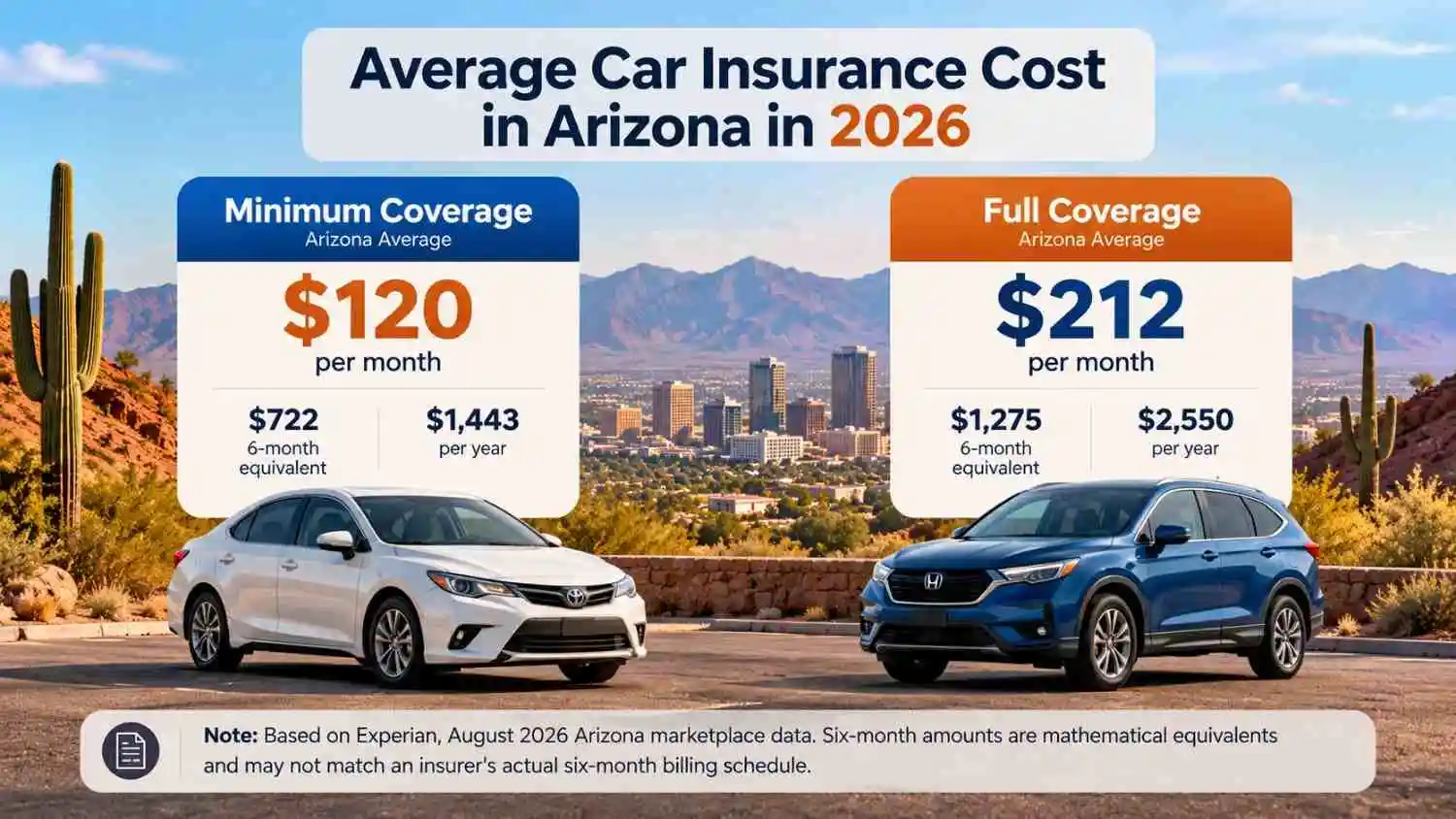
Experian reports an overall Arizona average of $1,920 per year, or $160 per month, based on policies sold through its automotive insurance marketplace. Looking at minimum and full coverage separately gives a much clearer picture because these policies do not provide the same level of protection.
| Coverage Type | Average Monthly Cost | 6-Month Equivalent | Average Annual Cost |
| Minimum coverage | $120 | About $722 | $1,443 |
| Full coverage | $212 | $1,275 | $2,550 |
Note: Experian, August 2026 Arizona marketplace data. Six-month amounts are mathematical equivalents based on the annual figures and may not match an insurer’s actual six-month billing schedule.
You may see different numbers when researching the average car insurance cost in Arizona. NerdWallet’s September 2026 analysis, for example, reports a statewide median of $2,947 per year for full coverage and $937 per year for minimum coverage. Those figures work out to roughly $246 and $78 per month when divided by 12.
The difference does not necessarily mean one set of numbers is wrong. Rate studies can use different driver profiles, vehicles, mileage assumptions, coverage limits, deductibles, insurers and data sets. NerdWallet’s rate analysis uses a defined sample driver and coverage profile, while Experian’s statewide averages are based on policies sold through its automotive insurance marketplace.
For an Arizona driver, these numbers work best as budgeting references. Personalized quotes using the same limits and deductibles are far more useful when you are deciding what a policy may actually cost you.
What Car Insurance Does Arizona Require?
Before comparing premiums, it helps to separate the insurance Arizona requires from the additional protection you may choose to purchase.
The Arizona Department of Insurance and Financial Institutions currently lists minimum liability limits of 25/50/15. That means at least $25,000 in bodily injury liability for one person, $50,000 when two or more people are injured or killed in an accident, and $15,000 in property damage liability.
These are legal minimums, not a guarantee that those amounts will cover the entire cost of a serious accident. Drivers can purchase higher liability limits depending on their needs, budget and available policy options.
Liability coverage also serves a different purpose from insurance protecting your own vehicle. Bodily injury liability generally addresses covered injuries to other people when you become legally responsible for an accident. Property damage liability generally addresses covered damage you cause to another person’s vehicle or property, up to your policy limits.
If you cause an accident that damages your own vehicle, liability coverage by itself generally will not pay to repair your car. That is one of the reasons the price of a minimum-liability policy should not be compared directly with a policy containing collision and comprehensive coverage without first looking at what each policy actually includes.
Minimum Coverage Car Insurance Cost in Arizona
Experian’s August 2026 marketplace data puts the minimum coverage car insurance cost in Arizona at an average of $1,443 per year, or approximately $120 per month. NerdWallet’s September 2026 analysis reports a lower statewide median, showing how much the result can change depending on the sample and methodology.
Minimum coverage can cost considerably less than broader protection because the insurer is taking on a different set of risks. A lower monthly premium should therefore be viewed alongside what the policy does and does not cover rather than as a cheaper version of an otherwise identical policy.
Arizona’s required liability coverage does not automatically protect your own car against theft, hail, flooding, fire or collision damage. Those losses may involve collision or comprehensive coverage, depending on what happened and the terms, exclusions and deductibles in the policy.
This distinction is especially useful when reviewing a vehicle insurance policy. A quote that costs $100 per month and another that costs $200 may appear easy to compare, but the difference becomes much more meaningful once you check liability limits, physical-damage coverage and deductibles.
What Does “Full Coverage” Actually Mean?
“Full coverage” sounds as though everything that could happen to a car will be covered. In practice, it is not a standardized policy name and does not mean unlimited protection. The term is commonly used for an auto policy combining liability coverage with collision and comprehensive coverage.
Collision coverage can help pay for covered damage to the insured vehicle following a collision, subject to the deductible and policy terms. Comprehensive coverage generally deals with specified non-collision losses such as theft, hail, fire, flooding, windstorms, falling objects, vandalism or animal impacts, again subject to exclusions and the deductible.
Liability coverage remains part of the policy, but its purpose is different. It generally addresses covered bodily injury or property damage for which the insured driver becomes legally responsible, up to the selected policy limits.
A full-coverage policy can therefore still leave you with out-of-pocket expenses. Deductibles, exclusions, coverage limits and optional benefits continue to matter. Two policies both advertised as “full coverage” may provide different amounts of protection.
Full Coverage Car Insurance Cost in Arizona
Experian’s August 2026 data reports an average full coverage car insurance cost in Arizona of $2,550 per year, or $212 per month. NerdWallet’s September 2026 statewide median is higher at $2,947 annually, equivalent to roughly $246 per month.
Neither number predicts an individual household’s premium. Your own quote is based on information that a statewide average cannot fully represent, including your vehicle, location, driving history, selected limits and deductibles.
Full coverage generally costs more than minimum liability because collision and comprehensive add protection for covered damage to your own insured vehicle. The insurer is taking on risks that are not included in a basic liability-only comparison.
Vehicle value can become particularly relevant here. Repairing or replacing a newer or expensive vehicle can expose an insurer to a larger potential physical-damage loss than some older, lower-value vehicles. Even so, the car’s value is only one part of the pricing calculation.
Why Arizona Car Insurance Prices Vary So Much
A statewide average combines many different drivers into a single number. An actual quote does the opposite: it looks at information connected to a specific driver, vehicle, location and policy. That is why the car insurance cost in Arizona can move substantially above or below the average.
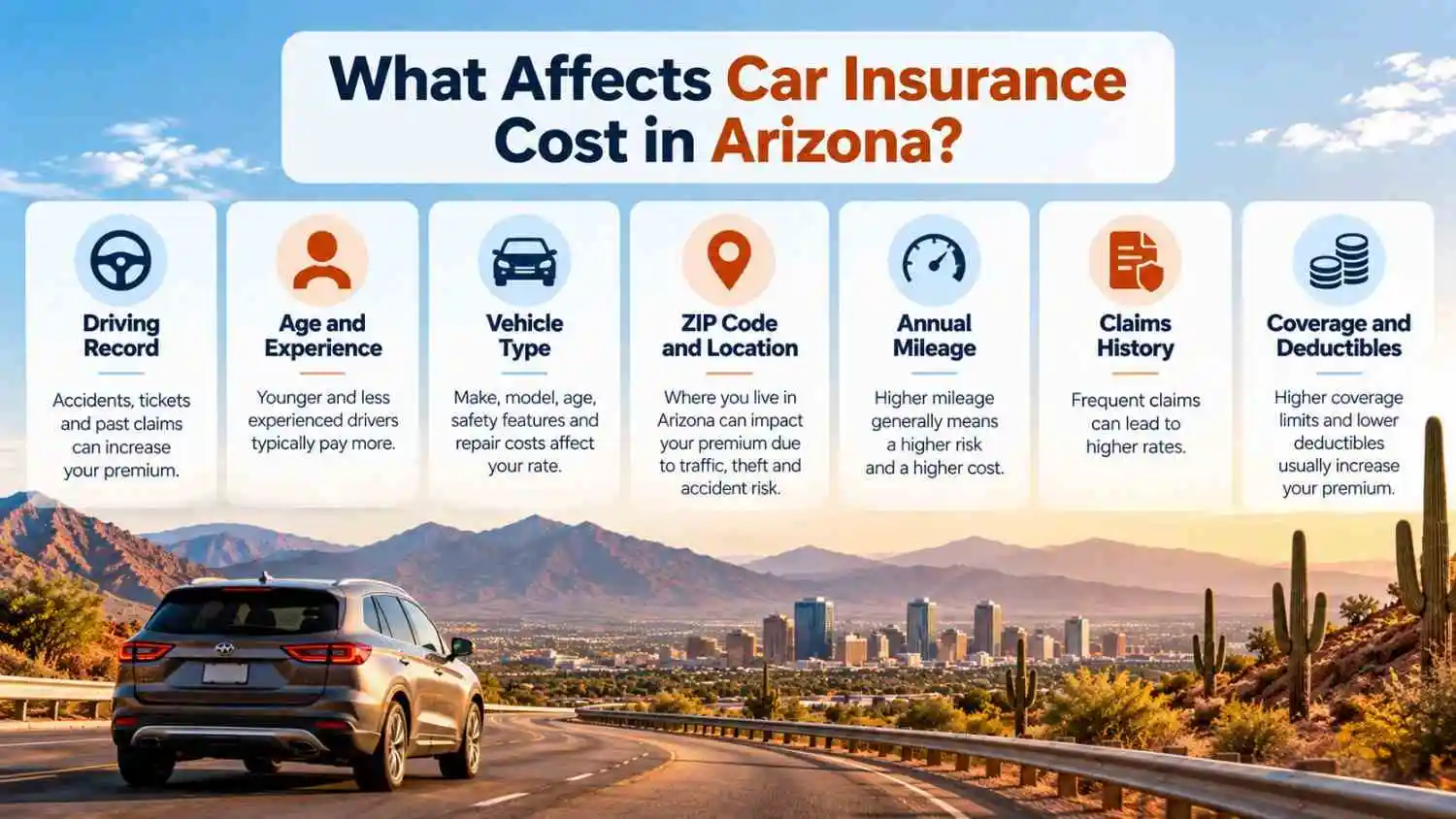
Driving Record
Your driving history can have a meaningful effect on price. Experian’s August 2026 Arizona data shows a blended average annual premium of $1,753 for drivers with a clean record, compared with $2,357 for drivers with one violation and $2,828 for those with three or more violations.
These are marketplace averages across minimum and full-coverage policies, not fixed penalties that every insurer applies. The numbers are better viewed as an illustration of how driving history can influence pricing rather than a prediction of what one ticket will cost you.
Arizona also has protections concerning accidents that were not the insured driver’s fault. DIFI states that insurers may not increase a premium because of an accident that was not caused or significantly contributed to by the insured’s actions.
Driver Age and Experience
A newly licensed driver has far less driving history than someone who has been behind the wheel for decades. Age and driving experience can therefore affect insurance pricing, but they do not determine the premium on their own.
A more experienced driver with recent violations may present a different risk profile from another experienced driver with a clean record. Vehicle type, mileage, location, coverage and other permitted rating factors still contribute to the final quote.
Vehicle Make, Model and Repair Cost
Purchase price is not the only vehicle-related factor that matters. Repair complexity, replacement parts, claims experience and other characteristics associated with a particular vehicle can influence what it costs to insure.
Modern cars often contain cameras, sensors, advanced lighting and driver-assistance equipment in bumpers, mirrors and windshields. Damage that appears minor from the outside may require replacement parts, electronics work and recalibration, making some repairs more expensive than expected.
Newer, high-value or high-performance vehicles may therefore cost more to insure for physical damage than some less expensive models. It is not a universal rule, however, because the driver’s full risk profile and insurer’s rating system still matter.
ZIP Code and Garaging Location
Where the vehicle is normally kept can also affect pricing. Location-related claims experience and other approved rating information are not identical throughout Arizona, so a statewide average cannot represent every city or neighborhood equally.
Experian’s July 2026 data illustrates the difference. Its reported overall monthly averages were $212 in Phoenix, $162 in Tucson, $180 in Mesa, $178 in Scottsdale and $119 in Yuma. These remain citywide averages rather than quotes for a specific ZIP code, driver or coverage package.
Location is therefore one piece of the pricing puzzle, not a shortcut for predicting someone’s premium. Two drivers in the same city can still receive very different quotes.
Annual Mileage and Vehicle Use
Someone who drives only a few thousand miles per year has different road exposure from a person with a long daily commute. Annual mileage and vehicle use may therefore be considered when an insurer calculates a rate.
The effect varies by company, so driving fewer miles does not guarantee a particular discount. Providing accurate mileage and usage information is more useful than assuming a specific number of miles will automatically lower the premium.
Claims History
Previous losses may also be relevant to underwriting and pricing where permitted. Arizona DIFI explains that insurers can use Comprehensive Loss Underwriting Exchange, or C.L.U.E., information when reviewing prior loss history.
If information in a C.L.U.E. report is incorrect, consumers have a process for disputing it. That can be worth investigating when a quote appears to reflect an accident or claim that does not belong to you.
Credit-Related Insurance Information
Arizona allows credit-history information to be used in determining insurance eligibility or price, subject to applicable requirements. The effect does not have to be identical from one insurer to another because companies can use different approved rating approaches.
This is another reason two drivers with similar cars and driving records can receive different quotes. Insurance pricing involves more information than vehicle make and accident history alone.
How Deductibles Affect Your Premium and Out-of-Pocket Cost
A deductible is not simply a number you increase to make the monthly premium smaller. It also determines how much of an eligible physical-damage loss you may have to absorb yourself before the insurer pays the remaining covered amount.
Suppose you are comparing two otherwise similar policies, one with a $500 collision deductible and another with a $1,000 deductible. The second option may have a lower premium because you are agreeing to take responsibility for a larger part of a covered loss.
If a covered collision resulted in $4,000 of eligible vehicle damage, a $500 deductible would generally leave you responsible for the first $500. With a $1,000 deductible, your share would generally be $1,000. Actual claim payments still depend on the policy terms and insurer’s claim determination.
The right comparison is therefore not simply “Which deductible gives me the cheapest premium?” It is whether the premium difference is worthwhile when weighed against the amount you could realistically afford after a covered claim.
Does an Older Car Always Cost Less to Insure?
Not necessarily. An older vehicle may have a lower market value, which can reduce physical-damage exposure in some situations, but age is not the only factor insurers consider. Repair availability, model-specific claims experience, theft exposure and the driver’s information can still affect the premium.
Owners of older paid-off vehicles sometimes review whether collision and comprehensive coverage continue to fit their needs as the car loses value. A useful comparison looks at the cost of those coverages alongside the vehicle’s current value, deductible and the owner’s ability to replace the car without an insurance payment.
There is no universal age at which collision or comprehensive should automatically be removed. Dropping physical-damage coverage may lower the car insurance cost in Arizona, but it also transfers more of the potential financial loss back to the vehicle owner.
Financed and Leased Cars Can Have Additional Requirements
Arizona’s legal minimum and a finance company’s insurance requirements are separate matters. State law establishes the liability insurance needed to satisfy financial-responsibility rules, while a lender or leasing company can impose additional requirements through the loan or lease agreement.
Collision and comprehensive coverage are commonly required for financed or leased vehicles because another party has a financial interest in the car. Someone carrying only Arizona’s minimum liability insurance could therefore satisfy the state requirement while failing to satisfy a lender’s contract.
Before removing physical-damage coverage to reduce the premium, check the finance or lease agreement. The cheapest policy is not useful if it fails to meet contractual requirements attached to the vehicle.
Liability-Only vs. Full Coverage in Arizona
The liability car insurance cost in Arizona can be substantially lower than a policy containing collision and comprehensive coverage. The reason becomes clearer when you compare what each type of policy is designed to address.
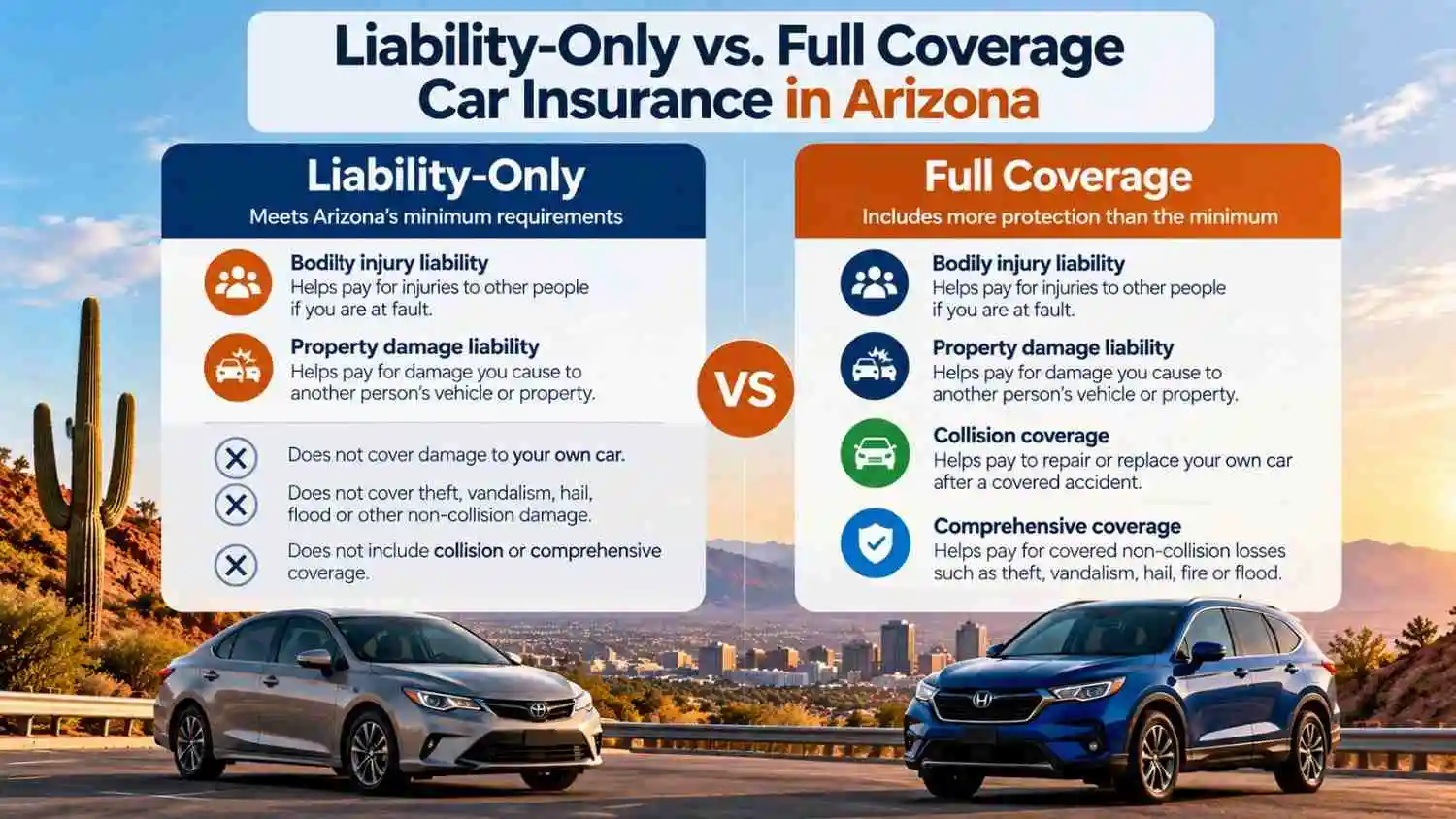
| Coverage Feature | Liability-Focused Policy | Broader “Full Coverage” Policy |
| Covered bodily injury liability | Included, subject to limits | Included, subject to limits |
| Covered property damage liability | Included, subject to limits | Included, subject to limits |
| Collision damage to your insured car | Generally not included | Typically included |
| Covered theft and weather damage | Generally not included | Typically covered through comprehensive |
| Physical-damage deductible | Not applicable if coverage is absent | Usually applies |
| May satisfy financed-car requirements | Often not by itself | May, depending on lender terms |
Imagine receiving one quote for $110 per month and another for $210. Calling the first one a better deal without checking the coverage could be misleading. The $100 difference may reflect higher liability limits, physical-damage protection or different deductibles rather than one insurer simply charging more for the same policy.
Why Two Similar Arizona Drivers Can Receive Different Quotes
Consider one driver with a clean record, an older paid-off sedan, moderate annual mileage and a $1,000 physical-damage deductible. Another has a recent at-fault accident, drives a newer high-value SUV, covers more miles each year and chooses a $500 deductible.
The second driver may receive a higher quote because several pricing factors have changed at once. Assigning an exact premium to either hypothetical driver would be misleading because only an insurer applying its current rating system could produce a genuine quote.
Even drivers who look similar can pay different amounts. Two people might own the same model, have clean records and select similar limits, yet receive different prices because of garaging location, annual mileage, claims history, discounts or the insurer’s rating methodology.
How to Compare Arizona Car Insurance Quotes Properly
A useful comparison starts with similar coverage. If one quote carries Arizona’s minimum liability limits while another includes higher limits, collision, comprehensive and additional protections, comparing only the monthly payment tells you very little.
Check bodily injury and property damage limits first, then look at collision and comprehensive coverage and their deductibles. Review uninsured and underinsured motorist selections, rental reimbursement, optional benefits, exclusions and the discounts already included in each quote.
Payment terms deserve attention as well. A low advertised monthly amount may be based on an installment arrangement, while another company may emphasize the six-month or annual premium. Looking at the total policy cost alongside the payment schedule makes the comparison more meaningful.
If you are still sorting out what belongs in an auto policy, Insurance Centrik’s information about choosing a vehicle insurance policy can provide useful background before comparing prices. The aim is to understand what each quote actually buys rather than automatically selecting the smallest number.
Rental Reimbursement and Rental Car Insurance Are Different
Rental-related terminology can become confusing after an accident. Rental reimbursement generally provides a specified amount toward temporary transportation following a covered loss when the policy’s requirements are met. Daily limits, maximum amounts and qualifying circumstances depend on the contract.
That is different from insurance associated with a vehicle you rent for a trip. Your personal auto policy may extend certain coverage to a rental vehicle in some situations, while the rental company or a credit card may offer separate forms of protection.
Insurance Centrik’s information about rental car after an accident can help explain temporary transportation following a covered loss, while its car rental insurance content deals with protection connected with renting a vehicle. These related topics are worth keeping separate because one type of coverage should not be assumed to replace the other.
Practical Ways to Potentially Lower Car Insurance Costs in Arizona
Comparison shopping is usually a better starting point than immediately reducing coverage. Insurers can price the same driver differently because their rating methods, claims experience and business costs vary. Ask for comparable limits and deductibles so that an apparent saving is not simply the result of buying less protection.
Discounts are also worth reviewing. Depending on the insurer and your eligibility, multi-car, multi-policy, safe-driver or usage-based programs may affect the premium. An advertised discount does not guarantee that every driver qualifies or that the savings will be the same from one company to another.
Driving information should remain accurate as well. A move, job change or switch to remote work can alter annual mileage. Updating outdated usage information gives the insurer a more accurate picture of how the vehicle is currently being driven.
Owners of older paid-off vehicles can reassess collision and comprehensive coverage, but the decision should include more than the premium. Vehicle value, deductibles and the ability to replace the car after a major loss all deserve consideration before reducing protection.
A higher deductible may also reduce the premium in some situations, but the trade-off is greater out-of-pocket responsibility after an eligible claim. None of these steps guarantees that the car insurance cost in Arizona will decrease, so compare the financial trade-offs rather than chasing a specific monthly number.
Monthly, Six-Month and Annual Premiums Can Mean Different Things
Auto insurance is often written for a six-month term, while consumers naturally think about the expense on a monthly basis. Rate studies may report annual figures and divide them by 12 simply to make comparison easier.
That arithmetic does not mean the resulting monthly number will appear on twelve identical bills. Payment-plan fees, paid-in-full discounts, policy terms and renewal changes can affect what a customer actually pays.
Experian’s $2,550 annual full-coverage average, for example, corresponds to about $212.50 per month mathematically and is published as $212 monthly. That does not mean an insurer will necessarily offer an individual Arizona driver a $212 monthly installment.
When reviewing an actual quote, compare the total premium for the policy term along with the payment schedule. That gives you a more complete picture of cost than the monthly figure alone.
Why Arizona Car Insurance Averages Differ Between Websites
Search how much is car insurance in Arizona, and you can quickly find numbers that appear to contradict each other. The difference usually becomes easier to understand once you look at how the rate was calculated.
Experian reports $212 per month for full coverage using August 2026 policies sold through its automotive insurance marketplace. NerdWallet’s September 2026 analysis reports a $2,947 statewide median annual full-coverage rate, equivalent to roughly $246 per month when divided by 12.
Rather than choosing whichever figure looks most convincing, check what it represents. Was the number an average or a median? Which driver and vehicle profile was used? What liability limits and deductibles were included? Was the study measuring minimum coverage, liability-only insurance or a broader full-coverage policy?
Those details turn a rate statistic into useful context. Without them, a precise-looking monthly figure can create the false impression that Arizona has one standard insurance price.
What to Check Before Buying or Renewing an Arizona Policy
Start with the liability limits rather than the monthly price at the top of the quote. Check whether the limits are simply Arizona’s legal minimum or something higher, and make sure you understand how much bodily injury and property damage liability the policy provides.
Next, review collision and comprehensive coverage and note their deductibles. Look separately at uninsured and underinsured motorist options, rental reimbursement and any other optional protection that matters to your circumstances instead of assuming those benefits automatically come with “full coverage.”
Financed and leased vehicles need an additional check. Compare the proposed policy with the lender or lessor’s requirements because meeting Arizona’s minimum liability rules does not necessarily satisfy the contract attached to the vehicle.
Finally, confirm the policy term, payment schedule and discounts already applied. Once those details are reasonably consistent across quotes, the premium becomes much more useful for comparison.
A Practical Way to Look at Arizona Car Insurance Costs
The car insurance cost in Arizona makes more sense as a range than as one fixed monthly price. Current averages can help you set expectations, but they cannot account for your driving record, vehicle, location, mileage, limits, deductibles and discounts all at once.
Before buying or renewing coverage, compare personalized quotes built around similar limits and deductibles rather than automatically choosing the lowest monthly payment. Read the policy details carefully and confirm questions about your specific coverage with the insurer or a licensed insurance professional. Insurance Centrik can help you understand insurance topics and coverage differences before you compare your available options.
FAQs
Is full coverage required by Arizona law?
No. Arizona's minimum requirement only covers liability — collision and comprehensive aren't mandatory by law. However, lenders or leasing companies may require them separately for financed or leased vehicles.
Does my ZIP code affect car insurance rates in Arizona?
Yes. Garaging location can affect pricing since insurers use approved location-related rating data. Citywide averages differ across Arizona, but they still can't predict an exact rate for a specific ZIP code or driver.
Can insurers use credit information in Arizona?
Yes. Arizona DIFI permits credit-history information to be used in determining insurance eligibility or pricing, subject to applicable requirements. The exact impact varies by insurer and policyholder.
Can a higher deductible lower my Arizona car insurance premium?
Yes, often. Raising your collision or comprehensive deductible can reduce your premium since you're accepting more out-of-pocket responsibility for a claim. Choose an amount you could comfortably afford if you needed to file.

Aarvith is the author and founder of Insurance Centrik. He researches various insurance topics, including auto, health, travel, home, and business insurance. He provides accurate insurance information from reliable sources and industry expertise.