
Does car insurance cover wildfire damage in California? Usually yes, but only if your policy includes comprehensive coverage. That optional coverage generally pays for fire and other non-collision damage to your own vehicle, minus your deductible. A liability-only policy, which is all California requires, does not pay to repair or replace your car.
What you actually collect depends on the policy in force when the damage happened, what caused the loss, your deductible and limits, and whether an exclusion applies. The sections below cover those pieces with California-specific rules and labeled examples.
Is Wildfire Damage Covered by Car Insurance in California?
Four conditions decide most wildfire car claims:
- Coverage was active – The policy has to be in force on the date of loss. As CBS News put it in its wildfire preparation guidance, the policies you have when the fire approaches are the ones you’re stuck with.
- Comprehensive (or equivalent physical damage coverage) was on the policy – It’s optional in California. Your declarations page shows whether you have it.
- The damage came from a covered cause – Fire and heat usually qualify, and smoke and ash may. Wear and mechanical breakdown do not.
- The numbers work – Your deductible comes off the payment, and the policy’s valuation rules cap what the insurer owes.
Scenario 1: a parked car destroyed by flames – A driver in a foothill town parks in the driveway before an evacuation order and later learns the car burned. With comprehensive coverage and a $500 deductible, the insurer would investigate, and if it accepts the claim it would likely treat the car as a total loss and pay its value less $500. Without comprehensive protection, the loss falls on the owner, subject to any other protection they may hold.
What Type of Car Insurance Covers Wildfire Damage?
Different coverages answer different questions, and readers often mix them up. Here is a quick map.
| Coverage | What it generally pays for | Wildfire damage to your own car? |
| Comprehensive | Non-collision damage: fire, theft, falling objects, flood, vandalism | Generally yes, after the deductible and subject to policy terms |
| Collision | Damage from hitting a vehicle or object, or a rollover | Not for fire itself; may apply if you crash while evacuating |
| Liability (bodily injury and property damage) | Injuries and property damage you cause to other people | No. It never pays for your own vehicle |
| “Full coverage” (informal label) | Usually liability + collision + comprehensive | Only if comprehensive is actually included |
| Rental reimbursement (optional) | Rental costs while a covered claim is handled | Not the damage itself; helps with transportation |
| GAP (optional or lender-sold) | Gap between a total-loss payment and what you owe on a loan or lease | Not repairs; applies only after a covered total loss |
Comprehensive Coverage
Comprehensive is the coverage built for events other than collisions: fire, hail, falling trees, floods, theft. Wildfire falls squarely into its territory. It typically responds to direct flame damage, heat damage such as melted trim and cracked glass, and in many policies smoke and soot damage.
The insurer, not the policyholder, makes the coverage call after reviewing the facts and policy language.
Liability Insurance
California requires drivers to carry liability coverage. Since January 1, 2025, the minimums under Senate Bill 1107 are $30,000 for injury or death to one person, $60,000 per accident, and $15,000 for property damage. Those limits pay for harm you cause to other people, not damage to your own vehicle.
Scenario 2: liability-only and a total loss – A driver in a wildfire zone carries only the legal minimum. Fire destroys the car in the driveway, and liability pays nothing for it. The owner absorbs the loss and, with a loan, still owes the lender.
Collision Coverage
Collision covers your car when it hits something. A wildfire that burns your car is not a collision, but evacuations are chaotic. If you rear-end another car on the way out, collision coverage may pay to repair your vehicle after your collision deductible, while your liability coverage may respond to the other driver’s damage if you’re found at fault.
Scenario 3: a crash during evacuation – A driver leaving a canyon in heavy smoke clips a stopped pickup. Her collision coverage (if she has it) addresses her own car; her property damage liability addresses the pickup. The crash is the cause of loss, so collision rules apply. Had a burning tree fallen on her car instead, comprehensive would be the likely home.
Full Coverage Car Insurance
“Full coverage” is shorthand, not a product. It usually means liability plus collision plus comprehensive, but one insurer’s version may omit rental reimbursement or carry a higher deductible than another’s. The reliable test is your declarations page: look for a comprehensive line with a dollar deductible.
What Types of Wildfire Damage Does Car Insurance Cover?
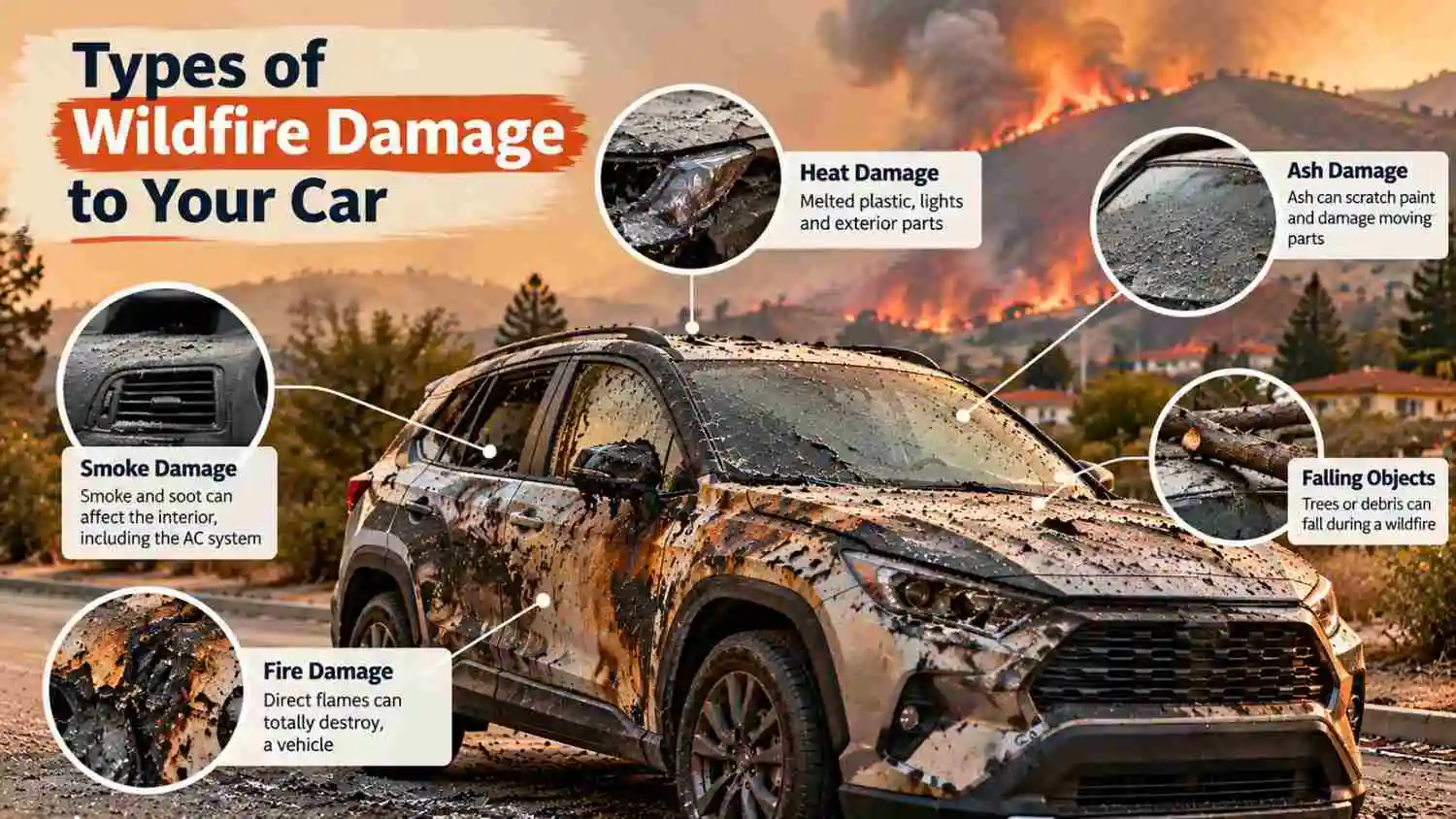
Under a comprehensive policy, these categories commonly come up:
- Direct fire and heat damage. Flames, or radiant heat that warps panels, cracks glass and melts lights without touching the car.
- Smoke, ash and soot. Odor and film in the cabin, vents and electronics; abrasive residue on paint.
- Fire-related electrical damage. Wiring melted or shorted because of the fire.
- Evacuation damage. Comprehensive or collision, depending on what happened (see below).
- Firefighting-related damage. A broken window or a car moved to clear a route can raise classification questions. Tell the adjuster exactly what happened.
Usually outside coverage: routine maintenance such as air-filter replacement, failures unrelated to the fire, pre-existing damage and wear. One automotive publication noted that smoke- or fire-induced corrosion and mechanical failure are commonly excluded. That’s a common pattern, not a universal rule; the policy wording controls.
Does Comprehensive Insurance Cover Smoke and Ash Damage?
Often, but the answer depends on the evidence. Some sources describe smoke damage as covered even if flames never touched the car; others warn that smoke alone may not support a claim. Documented physical damage tied to the wildfire is far stronger than a general complaint that the car “smells like smoke.”
Scenario 4: smoke and ash, no flames – After a nearby fire, a driver finds ash on the hood, a burnt smell in the cabin and a clogged cabin filter. The car runs fine. A detailer estimates $1,800 for interior remediation. With a $1,000 comprehensive deductible, a covered claim would pay about $800, and the driver must decide whether filing makes sense. The filter itself would probably count as maintenance.
Helpful evidence: photos and video before cleaning, dated records placing the car in the affected area, a written estimate from a qualified shop, cleaning receipts and the insurer’s coverage decision in writing. Don’t dry-wipe ash off paint, since it’s abrasive; rinse gently after documenting.
What Happens if Your Car Is Destroyed in a California Wildfire?
If the car is a total loss, the insurer typically pays what the vehicle was worth immediately before the fire, called actual cash value (ACV), less your deductible. A few California rules shape that process.
No fixed percentage – California doesn’t set a single total-loss percentage. Under Vehicle Code § 544, as summarized by a California consumer-law firm, a vehicle may be declared a total loss when it’s uneconomical to repair, and insurers weigh repair cost, ACV and salvage value.
Comparable vehicles – Under 10 CCR § 2695.8(b), an insurer may base a cash settlement on the cost of a comparable automobile less the deductible, with no deduction for condition unless the documented condition is below average for that year, make and model.
Sales tax and fees – A cash settlement must include applicable sales tax tied to the comparable automobile (adjusted if you keep the wreck). Law-firm summaries also point to license and transfer fees, so check the valuation report for these lines.
Salvage – A burned vehicle still has scrap or parts value, and the insurer typically takes it. California allows owner-retained salvage: the insurer subtracts salvage value from your payment, the car gets a salvage certificate under Vehicle Code § 11515 and must pass inspections before re-registration. For fire-destroyed cars that’s rarely practical.
Valuation disputes – Ask for the full valuation report, check trim, mileage and options, and confirm the comparables are recent and local. If you disagree, send your own listings in writing.
How Much Does Car Insurance Pay for Wildfire Damage?
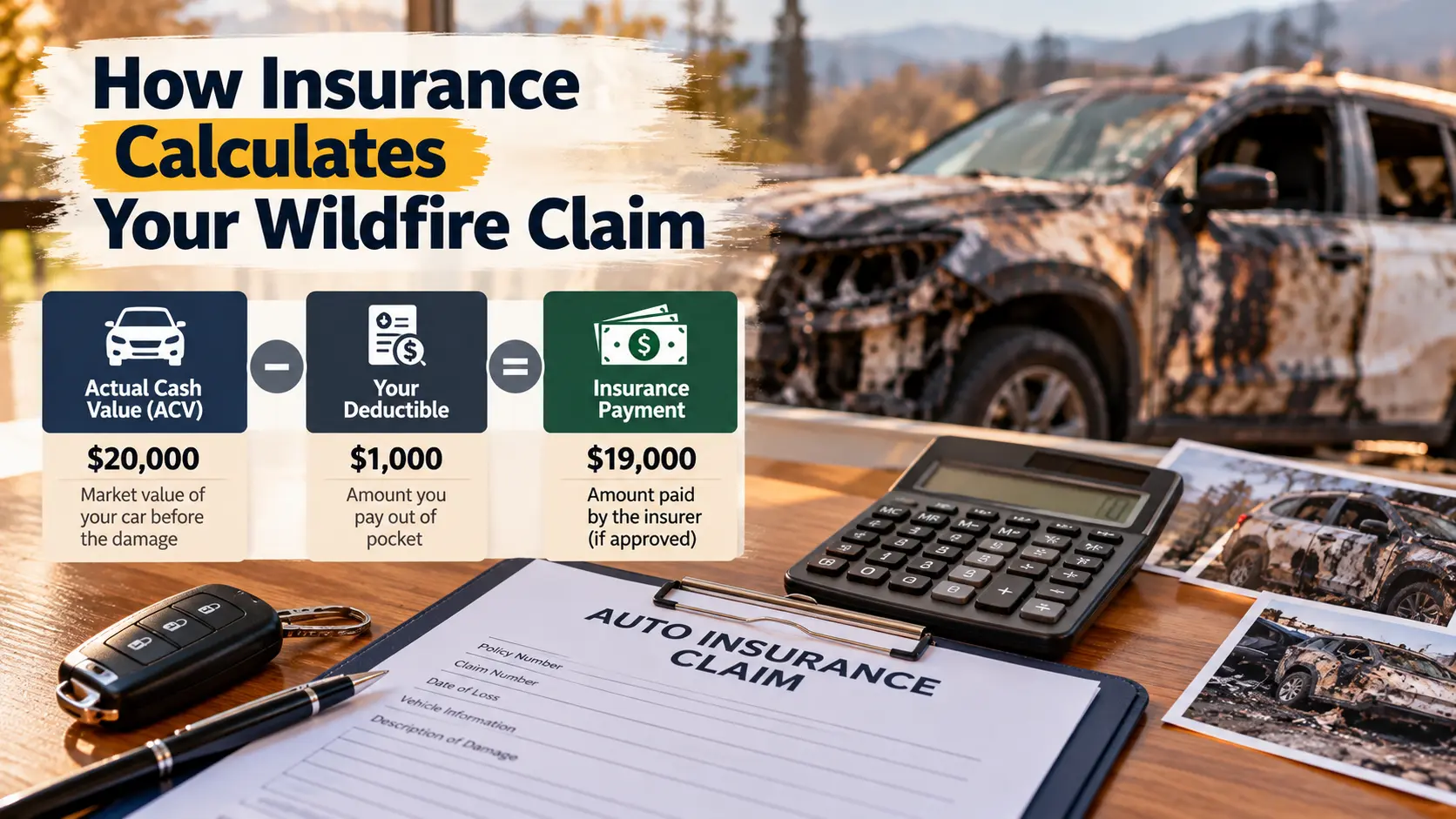
There’s no reliable statewide average to quote; payments depend on the car’s value, the damage, the deductible and the policy terms. Repair claims (smoke cleanup, a cracked windshield) pay the repair cost minus the deductible. Total-loss claims pay ACV minus the deductible, plus applicable tax and fees under California rules.
Illustrative Wildfire Damage Insurance Claim Payouts (hypothetical examples, not California averages)
| Scenario | Repair estimate or ACV | Comprehensive deductible | Potential insurer payment | Policyholder’s out-of-pocket |
| A. Burned vehicle, total loss | ACV $18,000 | $500 | $17,500* | $500 |
| B. Smoke and ash remediation | Estimate $1,800 | $1,000 | $800 | $1,000 |
| C. Minor heat damage (cracked glass) | Estimate $600 | $1,000 | $0 | $600 |
| D. Total loss, financed car | ACV $20,000; loan balance $24,000 | $1,000 | $19,000* | $1,000 deductible plus $5,000 loan shortfall (unless GAP applies) |
Note – Before any sales tax and fees added to a California cash settlement, and subject to policy terms. Every figure here is invented for illustration.
Scenario C shows why deductibles matter. If damage falls below the deductible, filing a claim produces no payment.
How to File a Wildfire Damage Car Insurance Claim in California
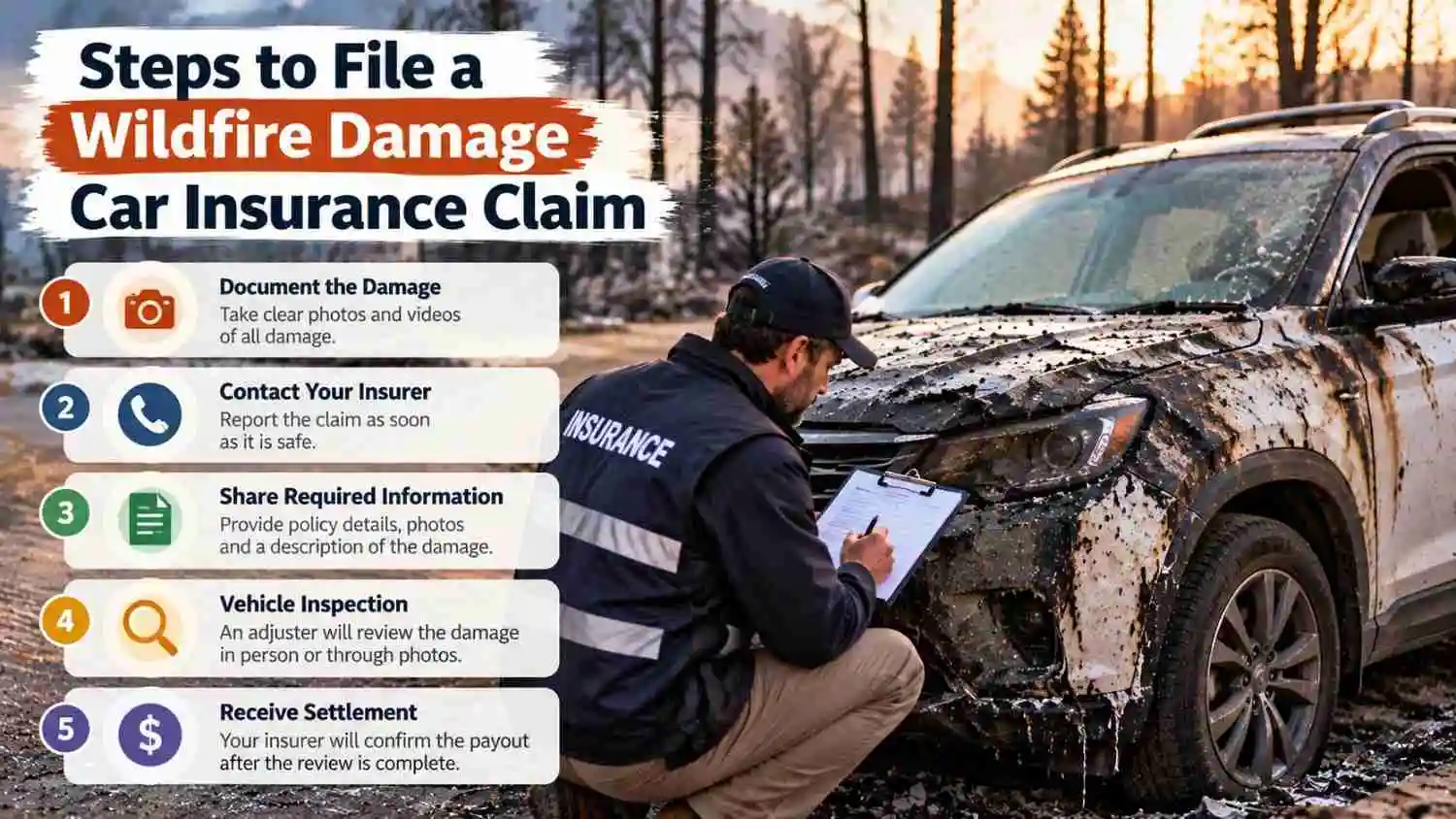
Practical order of operations:
- Safety first – Follow evacuation and re-entry orders. No car is worth a risk.
- Contact your insurer – Report the loss as soon as you can, by phone or the insurer’s app, and get a claim number. Ask what the insurer needs from you.
- Document when it’s safe – Once authorities allow access, photograph every side, the interior, the odometer, the VIN and any visible damage or ash before touching anything.
- Gather records – Policy declarations page, registration, loan or lease information, recent service records, aftermarket-equipment receipts and any photos showing the car’s pre-fire condition.
- Arrange the inspection – The insurer may send an adjuster or accept photos. Keep copies of every estimate.
- Review the decision – For a total loss, compare the valuation report to local listings. Review how the deductible, tax and fees were applied before accepting.
- Know your options if it stalls – Ask for explanations in writing, and see the denial discussion below.
Timing – California’s Fair Claims Settlement Practices Regulations set general clocks: an insurer must acknowledge a claim and begin any necessary investigation within 15 days of notice (10 CCR § 2695.5(e)), generally accept or deny within 40 days after receiving proof of claim (§ 2695.7(b)), and pay undisputed amounts within 30 days of acceptance (§ 2695.7(h)). Extensions and exceptions exist, so there’s no single answer, but those deadlines are the framework.
Rental coverage may keep you mobile meanwhile; how long insurers pay for a rental car after an accident varies by policy limit.
Can Your Car Insurance Claim Be Denied After a Wildfire?
Yes, claims can be denied or partly paid. Not every denial is improper, and not every one is justified; the reasons matter. Common grounds include no comprehensive coverage, a lapsed or canceled policy on the date of loss, a cause outside coverage (such as mechanical breakdown or wear), policy exclusions like commercial or rideshare use, insufficient documentation linking the damage to the fire, and misrepresentation.
If you get a denial or a low offer, ask for the policy language and reasoning in writing, request your policy and claim documents, submit your own estimates and comparable listings, and check for an appraisal clause and any deadline for suing. California’s regulations call for written notice of deadlines that could cut off your rights, and policy time limits vary.
You can also file a complaint with the California Department of Insurance, and a licensed attorney can advise on complicated disputes. Insurance Centrik can’t.
Will a Wildfire Damage Claim Increase Your Car Insurance Rates in California?
This is where the evidence is thinnest, and guessing would be wrong.
What’s established: Proposition 103, as summarized by consumer advocates, bars insurers from raising rates solely because of an accident that wasn’t your fault. California also limits why an insurer may cancel or refuse to renew a private auto policy; Insurance Code § 1861.03(c)(1) restricts them to a short list of grounds, including nonpayment of premium and a substantial increase in the hazard insured against.
What could not be confirmed: any California statute or CDI guidance saying whether a comprehensive wildfire claim can raise one driver’s premium. A fire loss isn’t a driving-record event like an at-fault crash, but insurers file their own rating plans, so ask yours in writing and compare how different car insurance companies in California treat comprehensive claims. A rate increase filed for many customers is a separate matter from an individual surcharge. And the temporary nonrenewal moratoriums California has issued after major fires were aimed at residential property policies; don’t assume they cover a car policy.
Does Car Insurance Cover Wildfire Damage During an Evacuation?
It can, depending on what happened. A parked or abandoned car that burns is a comprehensive matter. A crash with another vehicle or a guardrail falls under collision for your car, with liability responding to the other driver’s damage if you’re at fault. Keep receipts for towing and emergency repairs, and if you’re unsure how the insurer classifies the loss, ask for its explanation.
What Happens if a Financed or Leased Car Is Destroyed by Wildfire?
Your insurer’s obligation is to the car’s value, not your loan balance. A lender is typically listed as a loss payee, so the settlement goes to the lender first, and any remainder goes to you. If the payoff is bigger than the settlement, you owe the difference.
Scenario 5: financed car, total loss – A driver owes $24,000 on a loan. The car’s ACV is $20,000, and the deductible is $1,000. The insurer pays $19,000 to the lender. The driver still owes $5,000 plus the $1,000 deductible she’s already absorbed. If she bought GAP coverage and it applies to a covered total loss, it may pay the shortfall, and in some contracts reimburse part of the deductible, subject to exclusions such as past-due payments, fees or amounts financed beyond the contract’s terms.
Lenders generally want payments to continue until payoff is confirmed in writing. On a lease, the lessor owns the car and is paid first, so review the lease for GAP.
How Can California Drivers Protect Their Cars Before Wildfire Season?
Coverage bought after a fire has already damaged your car won’t reach that fire, so do the work in advance.
- Check your declarations page for comprehensive, the deductible, and any rental reimbursement or GAP.
- Pick a deductible you could pay tomorrow.
- Photograph the car yearly and keep the VIN, registration and loan details in cloud storage.
- Plan the evacuation – CBS News guidance suggests parking outside the garage facing the street, windows closed, keys with you.
- Review annually – Insurance Centrik’s resources on comprehensive auto insurance can help you prepare questions for your insurer.
Wildfire Car Insurance Coverage in California
Wildfires can cause serious damage to your car. If your insurance covers fire damage, it may help pay for repairs or replace your car if it’s destroyed. Basic liability insurance won’t cover damage to your own vehicle. Check your policy before wildfire season so you know what’s covered and how much you may need to pay.
FAQs
Does full coverage insurance include wildfire protection?
Only if comprehensive is part of the package. "Full coverage" isn't standardized, though it usually means liability, collision and comprehensive. Check your declarations page for comprehensive and its deductible rather than relying on the label.
Will my homeowners policy cover a car damaged in my garage?
Generally not. Homeowners policies usually cover the structure and personal belongings, while vehicles fall under auto insurance. Comprehensive is typically the coverage that responds to a burned car.
What if my claim is denied?
Ask for the reason and the policy language in writing, send supporting evidence and review any appraisal clause. You can file a complaint with the California Department of Insurance or consult a licensed attorney.
Can I buy comprehensive coverage while a wildfire is burning nearby?
Don't count on it. Insurers set their own limits on new coverage when a fire threatens an area, and coverage generally can't be added after a loss has occurred. No California rule found in this research requires an insurer to bind new coverage during an active fire.

Aarvith is the author and founder of Insurance Centrik. He researches various insurance topics, including auto, health, travel, home, and business insurance. He provides accurate insurance information from reliable sources and industry expertise.