

Dental insurance helps pay for checkups, fillings, crowns, and other dental care, but it works differently from health insurance. Most plans cover regular cleanings and exams at little or no cost, while you share the cost of fillings and bigger dental treatments. They also have a yearly limit on how much the insurance company will pay. Dental insurance costs in the U.S. depend on the type of plan, its coverage, and the benefits it offers. Knowing these details can help you choose a plan that fits your needs and budget.
What Is Dental Insurance and How Does It Work?
Dental insurance is a plan that pays part of your dental care costs in return for a monthly premium. Most plans cover preventive care first, then split the cost of fillings and larger procedures with you, up to a yearly maximum.
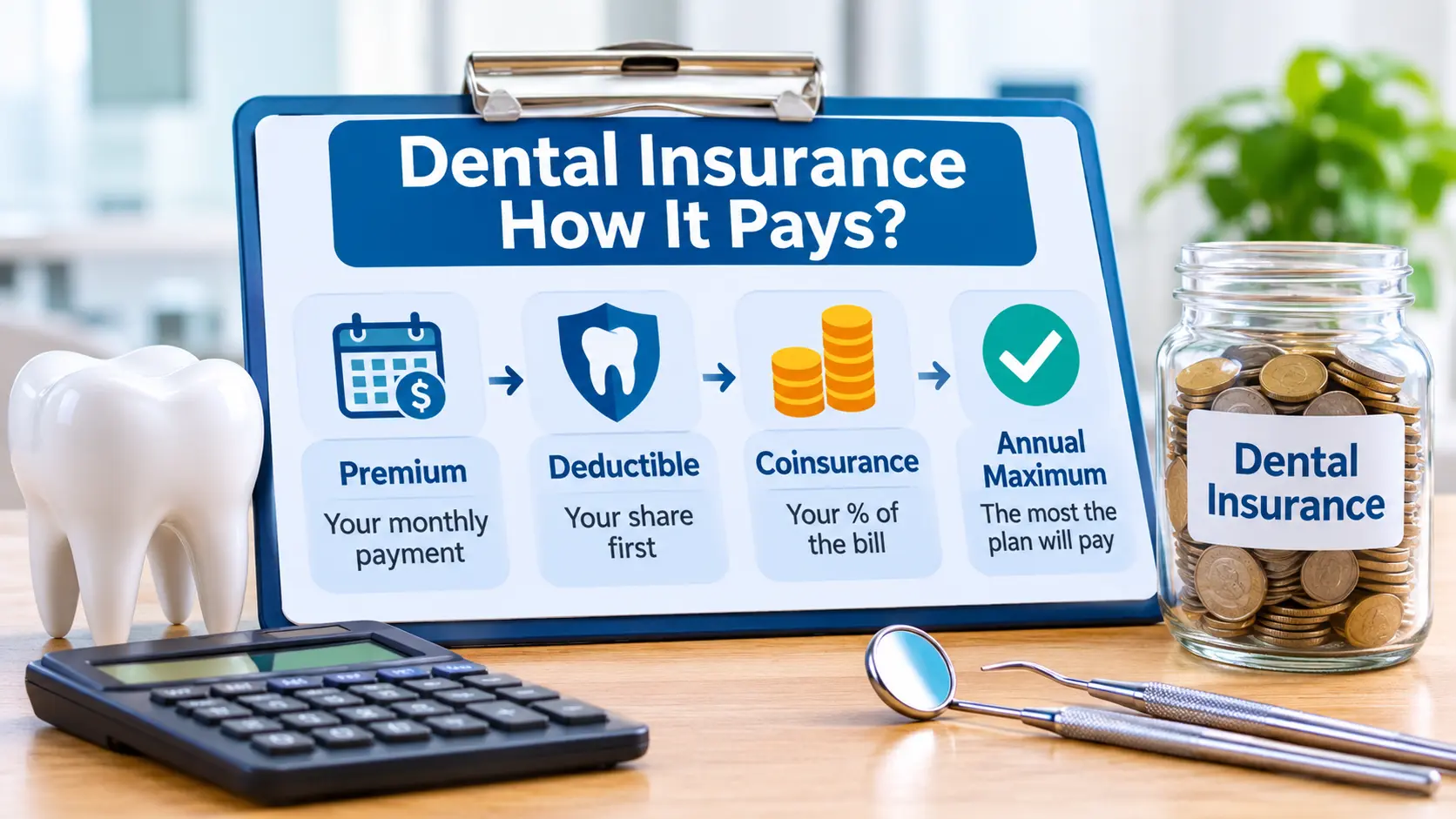
Think of it as cost sharing, not a full payment plan. You pay the premium. You often pay a deductible. Then you pay a share of each bill, called coinsurance or a copay. The insurer pays the rest until the plan’s annual limit runs out.
Dental insurance is built differently from medical insurance. Medical insurance generally helps protect you from large healthcare bills, such as a hospital stay. Dental plans are designed around routine, predictable care, so they come with lower premiums and much lower yearly limits. The National Association of Dental Plans (NADP) says dental premiums are roughly one-twentieth of medical premiums per person.
Here are the terms you will see in almost every plan:
- Premium: the amount you pay each month to keep the plan active.
- Deductible: the amount you pay yourself before the plan starts sharing costs for certain services.
- Coinsurance: your percentage of a covered bill, such as 20% of a filling.
- Copay: a fixed dollar amount you pay for a service, common in HMO-style plans.
- Annual maximum: the most the plan will pay in one plan year.
- In-network dentist: a dentist who has agreed to the plan’s discounted fees.
- Out-of-network dentist: a dentist who has no contract with the plan.
Nearly 284 million Americans, about 83% of the population, had some form of dental benefit at the end of 2024, according to the National Association of Dental Plans (NADP). That figure fell 2.3% from the year before. NADP says about 49% of commercial group dental benefits are employer-sponsored and 51% are voluntary benefits paid for by individuals.
How Dental Insurance Pays: Premiums, Deductibles, Coinsurance and Limits
Understanding the order of payment helps you predict a bill before the appointment. Most plans work like this:
- You pay the monthly premium all year, whether or not you visit a dentist.
- At the visit, the dentist bills a fee for each service.
- The plan applies its contracted rate if the dentist is in-network.
- You pay any deductible that applies, then your coinsurance or copay.
- The plan pays its share, until the annual maximum is used up.
The contracted rate matters. An in-network dentist agrees to charge no more than the plan’s negotiated fee for a covered service. An out-of-network dentist may charge more than the plan’s allowed amount. Depending on the plan and the state, you may be responsible for the difference. This is one reason a PPO plan costs less at in-network offices.
Worked example 1: a crown
This example uses made-up round numbers to show the math. It does not show real prices. Suppose your plan has a $50 deductible, covers major services at 50% and has a $1,500 annual maximum. You need a crown, and the in-network price is $1,200.
- You pay the first $50 as the deductible.
- The remaining $1,150 is split 50/50, so the plan pays $575.
- You pay $625 in total (50 deductible plus $575 coinsurance).
Worked example 2: reaching the annual maximum
Now suppose you already used $1,200 of your $1,500 maximum this year. You then need a $1,000 procedure covered at 50%. The plan would normally owe $500, but only $300 remains. The plan pays $300, and you pay $700.
Because most plans reset at the start of a new plan year, timing matters. Many people use a calendar year, but some plans use a different benefit year. Check your plan documents, because unused benefits usually do not roll over.
How Much Does Dental Insurance Cost?
Dental insurance premiums are lower than most other health-related premiums, but the premium is only part of what you pay. NADP estimates average monthly premiums at about $15.14 for individual DHMO plans and $41.76 for individual DPPO plans.
| Coverage source | Estimated monthly cost (NADP) |
| Individual DHMO plan | About $15.14 |
| Individual DPPO plan | About $41.76 |
| Employee share of an employer plan | About $13.08 (DHMO) to $34.71 (DPPO) |
Note: These are national averages. Your price depends on your location, age, plan type, annual maximum, provider network and whether the plan includes orthodontic coverage. Always check the quote for your own ZIP code and your own dentist.
NADP’s 2025 Dental Premium Report describes the eighth consecutive year in which premium increases stayed at or below annual inflation. That is a useful trend, but it does not guarantee your own renewal rate.
Employers still help pay for many workers’ coverage, but the employee share has grown. NADP reports that since 2010 the portion of employees paying the total premium themselves has doubled, from 10% to 20%.
Costs beyond the premium
Four other costs decide what you actually spend:
- Deductible: what you pay before the plan shares costs. Preventive care is often exempt.
- Coinsurance or copay: your share of each covered service.
- Annual maximum: after you reach it, you pay 100% until the plan resets.
- Non-covered services: anything excluded, or not yet covered because of a waiting period.
A simple way to judge whether a plan is worth the premium is to compare it with what routine care costs out of pocket. Looking at the dental cleaning cost without insurance gives you typical self-pay prices for the most common preventive visit, which you can set against a plan’s premium and cost sharing.
What Does Dental Insurance Cover?
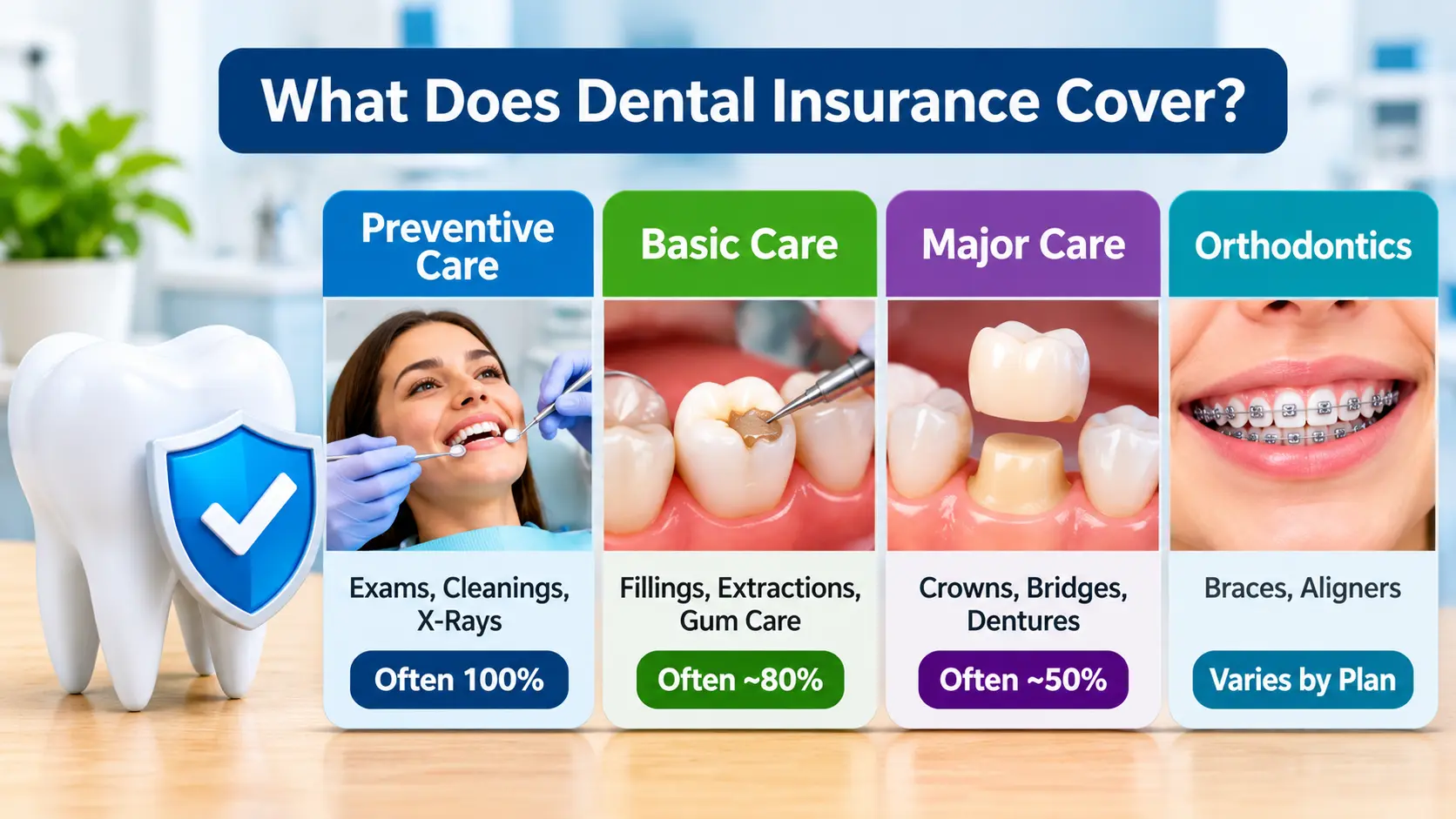
Most plans sort dental care into three tiers, and the tier decides how much the plan pays. The pattern is often called “100-80-50.” The plan pays about 100% of preventive care, about 80% of basic care and about 50% of major care. Exact percentages vary by plan, and some plans use different splits.
| Tier | Common examples | Typical plan share |
| Preventive | Exams, cleanings, X-rays, fluoride | Often 100% |
| Basic | Fillings, simple extractions, some gum care | Often around 80% |
| Major | Crowns, bridges, dentures, some root canals | Often around 50% |
| Orthodontics | Braces, aligners | Varies; often a separate limit |
The American Council of Life Insurers notes that major procedures such as crowns, bridges and dentures are typically covered at 50%.
Preventive care
Preventive care is the easiest part of a plan to use. Many plans cover exams and cleanings at or near 100%, and they often limit them to a set number per year. Using these benefits regularly is how most people get value from a plan, and it can help catch small problems before they become expensive ones.
Basic and major care
Fillings and simple extractions usually fall under basic care. Crowns, bridges and dentures usually fall under major care. Root canals are the tricky ones. Some plans treat them as basic care and others as major care, which changes your share of the bill. Coverage for root canal treatment varies by plan. Check the schedule of benefits to see whether your insurer classifies it as basic or major dental care.
What Dental Insurance Usually Does Not Cover
Every plan has exclusions, and they are where surprise bills come from. Common limits include:
- Cosmetic work. Teeth whitening and veneers are usually excluded.
- Orthodontics. Many plans exclude braces, or cover them only with an add-on, a separate limit or an age restriction.
- Implants. Coverage is often limited, partial or excluded.
- Replacement frequency. Some plans only pay to replace a crown or denture every several years.
- Missing tooth clause. Some plans will not pay for a bridge or implant to replace a tooth you lost before you enrolled.
- Alternate benefit clause. Some plans pay only toward a less costly treatment, even if you and your dentist choose a more expensive option. You pay the difference.
These clauses vary by insurer and policy. They appear in the plan’s official benefit documents, not in marketing summaries, so read the documents before you enroll. If a service matters to you, ask the insurer to confirm in writing how it is covered.
Types of Dental Insurance Plans
Dental coverage generally comes in four forms. The first three are insurance. The fourth is not.
| Plan type | How it works | Main trade-off |
| DPPO (preferred provider) | Choose any dentist; you pay less in-network | Higher premium; deductible and annual maximum |
| DHMO (managed care) | Pick a network dentist; fixed copays | Lower premium; smaller network; referrals for specialists |
| Indemnity (fee-for-service) | See any dentist; plan reimburses a share | Often higher cost and more paperwork |
| Discount (savings) plan | Membership fee for reduced prices | Not insurance; no claims paid |
Note: A market summary built on NADP’s 2025 report puts PPO plans at about 89% of commercial dental enrollment. That means a PPO is the option you are most likely to meet through an employer.
PPO and HMO plans are the two most common managed-care types, and they differ mainly in cost, network size and referral rules. A PPO generally lets you visit out-of-network dentists, but your costs may be higher, while an HMO usually limits you to its network and may require a referral for specialists. If you want to compare how PPO and HMO dental insurance work side by side, see our comparison of these two plan types. The comparison uses Illinois as an example, but the basic differences in network rules, costs, and referrals apply across the country.
Who each plan tends to suit
A PPO tends to suit people who want to keep their current dentist or expect to see specialists. A DHMO tends to suit people who are comfortable with a smaller network and want predictable copays. An indemnity plan may suit people who want more freedom to choose a dentist.
Discount plans deserve a careful look. You pay a fee, and participating dentists offer lower prices, but nothing is reimbursed and no annual maximum applies. They can help some people, but they are a different product from insurance, so compare the real prices before you pay the membership fee.
Waiting Periods and Annual Maximums
Two rules shape how useful a plan is in its first year and every year after.
Waiting periods
A waiting period is the time between your start date and when certain services become covered. Preventive care often starts right away. Basic and major care may carry a wait, and orthodontics often has the longest one. How long the dental insurance waiting period lasts for new policyholders depends on the plan, so it helps to know the typical timing and how to plan around it.
Waiting periods matter most for people who already know they need major work. If you need a crown or dentures soon, a plan with a long wait may not help this year, so ask about the waiting period for each tier before you enroll.
Annual maximums
The annual maximum is the most a plan will pay toward covered care in a plan year. ADA News summarized NADP data showing that 32.8% of in-network annual maximums fall between $1,000 and $1,500, and 48.2% fall between $1,500 and $2,500.
How many people reach their dental insurance annual maximum? Studies show different results. A 2024 study by the ADA Health Policy Institute found that 3.4% of dental patients reached their plan’s yearly limit. A February 2026 report by the CareQuest Institute found that 12% of adults with dental insurance said they had reached or gone over their yearly limit in the previous year.
The two studies used different methods and looked at different groups of people. The ADA study looked at dental patient records, while CareQuest asked adults about their experiences with dental insurance. These findings show why it is important to check a plan’s annual maximum before signing up.
If you mainly need cleanings and a filling now and then, the cap may never affect you. If you expect crowns, implants, dentures or several procedures in one year, the cap becomes one of the most important numbers in the plan.
Where Can You Get Dental Insurance?
You can get dental coverage through five main routes, and the rules differ for each one.
Employer and group plans
These are the most common. Your employer may pay part of the premium, and your share often comes out of your paycheck. Check the annual maximum, the waiting periods and the network before you accept, because group plans can differ a lot even within the same insurer. Most group plans also let you add a spouse and children, usually at a higher cost.
Individual plans
You can buy a standalone plan directly from an insurer. NADP estimates only about 4.8% of people with commercial dental benefits have individual coverage, so this is a smaller part of the market. If you are self-employed, between jobs or retired, it may be your main option. Because you pay the whole premium, compare the annual maximum and waiting periods carefully.
The Health Insurance Marketplace
HealthCare.gov explains that dental coverage for children 18 and younger is an essential health benefit. That means it must be available to you, either inside a health plan or as a standalone dental plan. You do not have to buy it. Adult dental is not an essential health benefit, so health plans do not have to offer it.
In practice, adult dental is rarely built into Marketplace health plans. One analysis of 2023 coverage, published by HealthInsurance.org, found that more than 91% of Marketplace health plans did not include embedded adult dental. Adults can usually buy a standalone dental plan, and in the states that use HealthCare.gov you generally must also enroll in a Marketplace health plan to add one. Standalone adult plans often have fairly low annual caps.
For children, the same source reports that as of 2025 the out-of-pocket cap for certified standalone pediatric dental plans was $425 for one child and $850 for multiple children. These limits change by year, so check the current figure on HealthCare.gov.
Medicare
This is the route that surprises people the most. Medicare.gov states that in most cases Medicare does not cover dental services, and that you pay all costs for non-covered services. Its list of what Original Medicare does not cover names routine cleanings, fillings, extractions and dentures as examples. We cover this in more detail in the senior section below.
Medicaid and CHIP
Public programs such as Medicaid and the Children’s Health Insurance Program provide dental benefits to many people. NADP counts them as part of the national dental benefit total. What adults receive varies by state, so check with your state Medicaid agency for current rules.
Dental Insurance for Seniors, Families and Individuals
Your age and household change which features matter most. The sections below cover the most common situations.
Why seniors need to plan carefully
Dental needs often change with age. Crowns, bridges, dentures and gum care become more common, and these fall into the major tier where plans pay the least. At the same time, many people lose employer coverage when they retire. NADP’s 2025 report on retiree oral health found that only about 70% of seniors have some form of dental coverage.
Seniors also run into the waiting-period problem more often than others. A person who enrolls at 66 because a tooth is already failing may find that major work is not covered for months. Because dental plans, networks and prices are sold locally, a state-level comparison can help. Looking at the best dental insurance for seniors in Texas shows how those trade-offs play out in one large state, and the same questions apply wherever you live.

What Original Medicare covers for dental
Original Medicare (Parts A and B) does not cover routine dental care. It covers a narrow set of situations, such as dental work needed because of a covered medical service. Medicare.gov, for example, describes tests and treatments to remove an oral or dental infection before and during covered dialysis for people with end-stage renal disease. Healthline also notes that an extraction may be covered when doctors say it is necessary before a covered procedure such as heart surgery or radiation therapy.
Medicare Supplement (Medigap) policies generally do not add dental coverage either. Insurer resources, including HealthSpring, say these policies help with cost sharing for services Original Medicare covers, not extra services such as dental.
Medicare Advantage dental benefits
Many Medicare Advantage (Part C) plans include some dental coverage, but the benefit varies a great deal from plan to plan. A white paper from the American Association of Oral and Maxillofacial Surgeons reported that in 2021, 94% of Medicare Advantage enrollees had access to at least some dental coverage. It also reported that 78% of enrollees faced annual limits of $1,300 or less, and 59% faced limits of $1,000 or less. That is 2021 data, so check current plan documents.
When you compare Medicare Advantage plans, look at the same items you would check on any dental plan: covered services, the annual maximum, the dentist network, waiting periods and whether the plan needs prior approval for major work. A plan that lists dental as a benefit may still leave you with a large bill for a set of dentures.
Standalone senior dental plans
Some seniors keep Original Medicare and buy a separate dental plan. This can give you a bigger network or a higher annual maximum than some Medicare Advantage dental benefits, but you pay a separate premium. Before you enroll, ask three direct questions:
- Which procedures have a waiting period, and how long is it?
- What is the annual maximum, and does it apply to all services?
- Does the plan have a missing tooth clause, or a limit on replacing dentures?
If you cannot wait, look for plans that start coverage sooner. The questions to ask apply to older adults in every state: which procedures have a waiting period, how long it lasts, and whether the annual maximum is lower. Some plans that offer shorter waits have lower annual maximums or higher premiums, so weigh the trade-off.
Families with children
Children’s dental needs often center on preventive care, sealants, fluoride and, for many families, braces. Because pediatric dental is an essential health benefit on the Marketplace, families have a clear route to coverage there. Employer plans usually allow you to add children to the plan.
When you compare dental insurance plans for families, check whether the deductible applies per person or has a family cap, whether orthodontics has its own limit and waiting period, and whether each child’s care counts against one shared annual maximum or separate ones.
Individuals and the self-employed
If you are self-employed or between jobs, a standalone plan is usually the main choice. You are likely paying the full premium, so the value test matters more. A lower-priced DHMO may work well if you are comfortable with a small network. A PPO may make more sense if you want to keep your current dentist or expect major work. Compare the cost for the year, not only the monthly price.
Is Dental Insurance Worth It? How to Compare and Use a Plan
It depends on how much dental care you expect to use. The simplest test is to compare one year of premiums plus your expected out-of-pocket costs with what you would pay without a plan.
A simple value check
- Multiply the monthly premium by 12.
- List the care you expect this year, including cleanings, X-rays, fillings and any known major work.
- Estimate your share under the plan, including the deductible, coinsurance and any services still in a waiting period.
- Add the premium and your share together.
- Compare that total with your estimated self-pay cost for the same care.
Dental insurance may offer more value to people who use preventive services regularly or expect covered treatment during the plan year. However, waiting periods, annual maximums, deductibles and coinsurance can reduce the financial benefit. Compare the total estimated cost of using the plan with the cost of paying for the same services yourself.
What to Compare When Choosing Dental Insurance
When comparing dental insurance plans, do not focus only on the monthly premium. The deductible, annual maximum, waiting periods, dentist network and coverage for expected treatments can all affect your total expenses. Review these details in each plan’s official documents before making a decision.
How to get the most from your plan
A few habits can keep your costs down once you are enrolled:
- Use preventive benefits. Cleanings and exams are often covered at or near 100%, so skipping them may mean missing preventive benefits included in your plan.
- Stay in network. In-network dentists charge contracted rates, which usually lowers your share.
- Ask for a cost estimate before major work. Many dental offices can send a treatment plan to the insurer to estimate what the plan will pay. Ask whether your plan offers this.
- Track your annual maximum. If you are close to the cap late in the year, ask your dentist whether non-urgent treatment can safely wait until the plan resets. Never delay treatment your dentist says is urgent.
- Keep your explanation of benefits. It shows what the plan paid and why, which helps if you need to question a claim.
If a claim is denied, ask the insurer for the reason in writing and the steps to appeal. If you cannot resolve it, you can contact your state’s insurance department.
FAQs
Does Medicare cover dental?
In most cases, no. Medicare.gov says Medicare does not cover most dental services, with narrow exceptions tied to covered medical care. Some Medicare Advantage plans offer dental benefits, so review each plan's details.
How much does dental insurance cost per month?
NADP estimates average individual premiums at about $15.14 for DHMO plans and $41.76 for DPPO plans. Employee shares of employer plans average about $13 to $35. Your price depends on location, plan type and benefits.
What is the best dental insurance for seniors?
There is no single best plan, because needs, budgets and local plan options differ. Compare the annual maximum, waiting periods, network and exclusions, and check which options are sold in your state.
Is there dental insurance with no waiting period?
Some plans reduce or waive waiting periods, often with trade-offs such as a lower annual maximum or a higher premium. Read the plan documents carefully, and confirm any waiting period in writing before you enroll.
Can I get dental insurance without health insurance?
Sometimes. Standalone dental plans are sold directly by insurers. On HealthCare.gov, however, you generally need to enroll in a Marketplace health plan to add a dental plan.
Is a dental discount plan the same as dental insurance?
No. A discount plan charges a membership fee for reduced prices at participating dentists. It does not reimburse claims and has no annual maximum, so it works differently from insurance.
What to Check Before You Choose a Plan
Dental insurance can lower the cost of regular care, but it rarely covers everything. Most plans pay well for cleanings and exams, share the cost of fillings, and pay much less for crowns, bridges and dentures. Because of the annual maximum and waiting periods, the price you see on a quote is not always the price you end up paying.
Before you enroll, check these items in the plan’s official documents:
- Annual maximum: the most the plan will pay in a year, and whether it applies to all services.
- Waiting periods: which services have a wait, and how long it lasts.
- Network: whether your dentist is in-network, since this changes your share of every bill.
- Exclusions and limits: orthodontics, implants, missing tooth clauses and replacement frequency.
- Total yearly cost: the premium, plus the deductible and coinsurance you expect to pay for the care you need.
Compare the estimated yearly cost rather than looking only at the monthly premium. A plan that costs a little more each month may still save you money if it offers a higher annual maximum or shorter waiting periods. If you need dental treatment soon, ask the insurer to confirm the coverage details in writing before enrolling.
If you are still comparing options, our dental insurance section covers related topics, from waiting periods and plan types to coverage for families and older adults.

Aarvith is the author and founder of Insurance Centrik. He researches various insurance topics, including auto, health, travel, home, and business insurance. He provides accurate insurance information from reliable sources and industry expertise.