

Renting a car in California sounds simple until you get to the counter and the agent starts listing insurance add-ons you weren’t expecting. Do you need the collision waiver? Does your personal auto policy already cover this? Is your credit card enough? Most renters say yes to everything just to avoid the awkward pause, and that single decision can add anywhere from $10 to over $50 a day to the final bill when it comes to car rental insurance in California.
In California, you’re not legally required to buy the rental company’s insurance to drive off the lot, but you are required to have some form of liability protection in place while driving. Many renters already have this covered through a personal auto policy or a credit card benefit. The right move is to check what you already have before you pay for coverage you don’t need, or skip coverage you actually do need.
What Is Rental Car Insurance, Exactly?
Rental car insurance is a set of optional protection products sold by rental companies — and, separately, by third-party providers — that cover different risks tied to driving a car you don’t own. It’s a different animal from your personal auto policy, which is part of why the two get confused so often.
At the counter, you’ll typically see four separate products, sold either bundled together or individually:
1. Collision Damage Waiver (CDW) or Loss Damage Waiver (LDW): Covers repair or replacement costs if the rental car is damaged or stolen. Technically, this isn’t insurance at all — it’s a waiver where the rental company agrees not to hold you responsible for damage, minus a list of exclusions.
2. Supplemental Liability Insurance (SLI): Extends protection if you injure someone else or damage their property while driving the rental.
3. Personal Accident Insurance (PAI): Covers medical costs for you and your passengers after an accident.
4. Personal Effects Coverage (PEC): Reimburses you if personal belongings are stolen from the rental car.
For a deeper breakdown of how each of these products functions and when they actually pay out, our guide on rental car insurance plans covers the mechanics in more detail.
Do You Legally Need Rental Car Insurance in California?
This is where a lot of confusion starts. California requires every driver to carry proof of financial responsibility, and as of January 1, 2025, the state’s minimum liability limits jumped from the old 15/30/5 standard to 30/60/15 — meaning $30,000 in bodily injury coverage per person, $60,000 per accident, and $15,000 in property damage coverage. That change, passed under Senate Bill 1107, was the first increase to the state’s minimums since 1967.
Here’s the part that trips people up: that requirement applies to you as a driver, not specifically to the rental transaction itself. Rental companies build minimum liability coverage into every rental to keep the vehicle road-legal, so you’re never technically driving off the lot uninsured. What’s optional is everything layered on top of that baseline — the CDW, the supplemental liability boost, the accident coverage, and the personal effects protection.
So to be direct: no, California doesn’t force you to buy the rental counter’s add-on products. But it does mean you should know what basic liability protection is already built into the rental, and whether that’s actually enough for your situation before you decline everything else.
What Does Rental Car Insurance Cost in California?
Pricing varies by rental company, vehicle class, and pickup location, but average daily rates across the U.S. rental market in 2026 tend to fall into fairly predictable ranges.
| Coverage Type | Typical Daily Cost | What It Covers |
| Collision Damage Waiver (CDW/LDW) | $15 – $42/day | Damage or theft of the rental vehicle |
| Supplemental Liability Insurance (SLI) | $10 – $17/day | Injury or property damage you cause to others |
| Personal Accident Insurance (PAI) | $6 – $9/day | Medical costs for you and passengers |
| Personal Effects Coverage (PEC) | $1 – $6/day | Theft of belongings from the rental car |
| Full bundle (all four combined) | $40 – $60/day | All of the above together |
A full counter bundle covering CDW, SLI, PAI, and PEC together commonly adds $280 to $420 to a one-week rental. For California specifically, one major rental provider notes that CDW pricing on California rentals can range from roughly $11 up to $500 per day depending on the vehicle class, since luxury cars and SUVs carry far higher repair costs than a standard economy sedan.
If that range feels wide, it is — a compact sedan picked up in Sacramento and a convertible rented at LAX are not priced the same way. If you’re trying to get a sense of what driving costs generally look like in one of the state’s biggest cities, our breakdown of car insurance costs in Los Angeles is a useful companion piece, since rental pricing tends to track local risk factors in a similar way to personal auto premiums.
Third-Party Providers Are Often Cheaper
Standalone rental insurance providers, purchased online before you arrive at the counter, are consistently priced below what rental companies charge directly. Third-party providers such as Allianz, Bonzah, and RentalCover routinely sell equivalent CDW coverage for a fraction of counter rates, and industry pricing data shows these providers can charge roughly 40% to 65% less on average than the rental counter for the same protection. If you know you’ll want a damage waiver regardless of what your personal policy covers, it’s worth pricing this out a day or two before pickup rather than deciding on the spot under time pressure.
Does Your Personal Auto Insurance Already Cover a Rental?
For most California drivers with a standard policy that includes collision and comprehensive coverage, that protection typically extends to a rental car used for personal trips within the U.S. This is the single most overlooked money-saver in the entire rental process — plenty of renters pay for a CDW they didn’t actually need because they never checked their own declarations page first.
That said, there are real gaps worth knowing about:
- International rentals are often excluded, even if your policy is otherwise comprehensive.
- Luxury or specialty vehicles may exceed what your policy is rated to cover, leaving you responsible for the difference if the rental is totaled.
- Rentals longer than 30 days sometimes fall outside standard personal auto terms.
- Business use of a rental car is frequently excluded from a personal policy altogether.
Before declining the counter’s collision waiver, call your insurer or check your policy documents. It takes about five minutes and can save $20 to $40 a day on a trip.
What About Credit Card Rental Coverage?
Many travel-focused credit cards include rental car protection as a cardholder perk, and it’s worth checking this before assuming you need to buy anything extra. To activate it, you generally need to decline the rental company’s CDW and pay for the entire rental with the eligible card — partial payments or switching cards mid-rental can void the benefit entirely.
A few things worth understanding about how this actually works:
1. Primary vs. secondary coverage – Primary coverage pays out directly, without touching your personal auto insurance first. Secondary coverage only kicks in after your own policy has been used, meaning you may still face a claim and a deductible on your personal policy before the card benefit helps.
2. Coverage is usually limited to vehicle damage and theft – Most credit card benefits do not include liability coverage for injuries or property damage to others, so you may still want SLI if your personal liability limits are on the lower end.
3. Exclusions exist for certain vehicles – Trucks, cargo vans, and exotic or luxury rentals are commonly excluded from card benefits, even premium travel cards.
If you rent cars frequently, it’s worth digging into your specific card’s rental benefits guide once, rather than re-checking the fine print every single trip.
Step-by-Step: How to Decide What You Actually Need
Instead of guessing at the counter, work through this order before your next rental:
Check your personal auto policy first – Confirm whether collision and liability coverage extend to rentals, and note your deductible.
Call your credit card issuer – Ask specifically whether the rental benefit is primary or secondary, and which vehicle types are excluded.
Compare rental company pricing against third-party providers – If you’ll need a standalone CDW, price it out in advance rather than deciding at the counter.
Match coverage to the trip – A weekend rental in a familiar city carries different risk than a two-week road trip through unfamiliar mountain roads or desert routes.
Decide on liability limits – If your personal policy’s liability limits sit close to California’s 30/60/15 minimum, consider adding SLI for extra protection, especially in higher-traffic metro areas like Los Angeles or the Bay Area.
Common Mistakes Renters Make in California
- Assuming the rental counter’s built-in liability coverage is sufficient – Rental companies typically build in coverage at the state’s legal minimum, which now stands at 30/60/15 in California. That’s fine for a minor fender-bender, but if you cause a serious accident involving injuries or a totaled vehicle, those limits can be exhausted fast, leaving you personally responsible for the rest.
- Buying duplicate coverage – This is the single most common overspend at the rental counter. If your personal auto policy already includes collision and comprehensive coverage, or your credit card offers primary CDW protection, paying $20 to $40 a day for the rental company’s waiver is money spent on protection you already have.
- Skipping the fine print in the contract – Every waiver comes with exclusions, and they’re rarely read closely at pickup. Common ones include damage from off-road or unpaved driving, letting an unauthorized driver take the wheel, or violating the agreed daily mileage cap. Any of these can void your coverage entirely, right when you need it most.
- Forgetting about “loss of use” fees – Even with a damage waiver, some rental companies charge you a separate daily fee to cover their lost rental income while the car is being repaired. This fee isn’t always included in a standard CDW, so it’s worth asking directly whether it’s covered before you sign.
- Not comparing rates across cities – Rental insurance pricing isn’t flat across California. A CDW quoted in Los Angeles can run noticeably higher than the same product in a smaller market, largely because base rental rates and local claims history both factor into the price, much like ZIP-code-based pricing does for personal auto premiums.
Tips for Car Rental Insurance in California
Bringing it all together, here’s the practical checklist for anyone renting a car in California:
- Verify your existing coverage before you get to the counter — both your auto policy and your credit card benefits.
- Confirm whether liability coverage in the rental meets or exceeds California’s 30/60/15 minimum, and add SLI if your own limits run low.
- Price third-party CDW options in advance if you already know you’ll want a damage waiver.
- Read the exclusions section of the rental agreement, not just the marketing name printed on the product.
- Match coverage to the vehicle class. A rented SUV or luxury car carries higher CDW costs, and higher stakes if it’s damaged.
- Keep records of your decline if you turn down coverage, in case a dispute comes up later about what was actually offered at pickup.
- Reassess coverage for out-of-state or international trips, since protection that works fine driving around Sacramento may not travel with you across a border.
These same principles apply broadly, whether you’re comparing options because you’re relocating, traveling for work, or simply renting for a weekend getaway. If you’re weighing rental protection alongside your everyday auto coverage, our comparison of the best car insurance companies in California can help you see how personal auto rates and rental-friendly policies stack up across major carriers statewide.
How California Compares to Other States
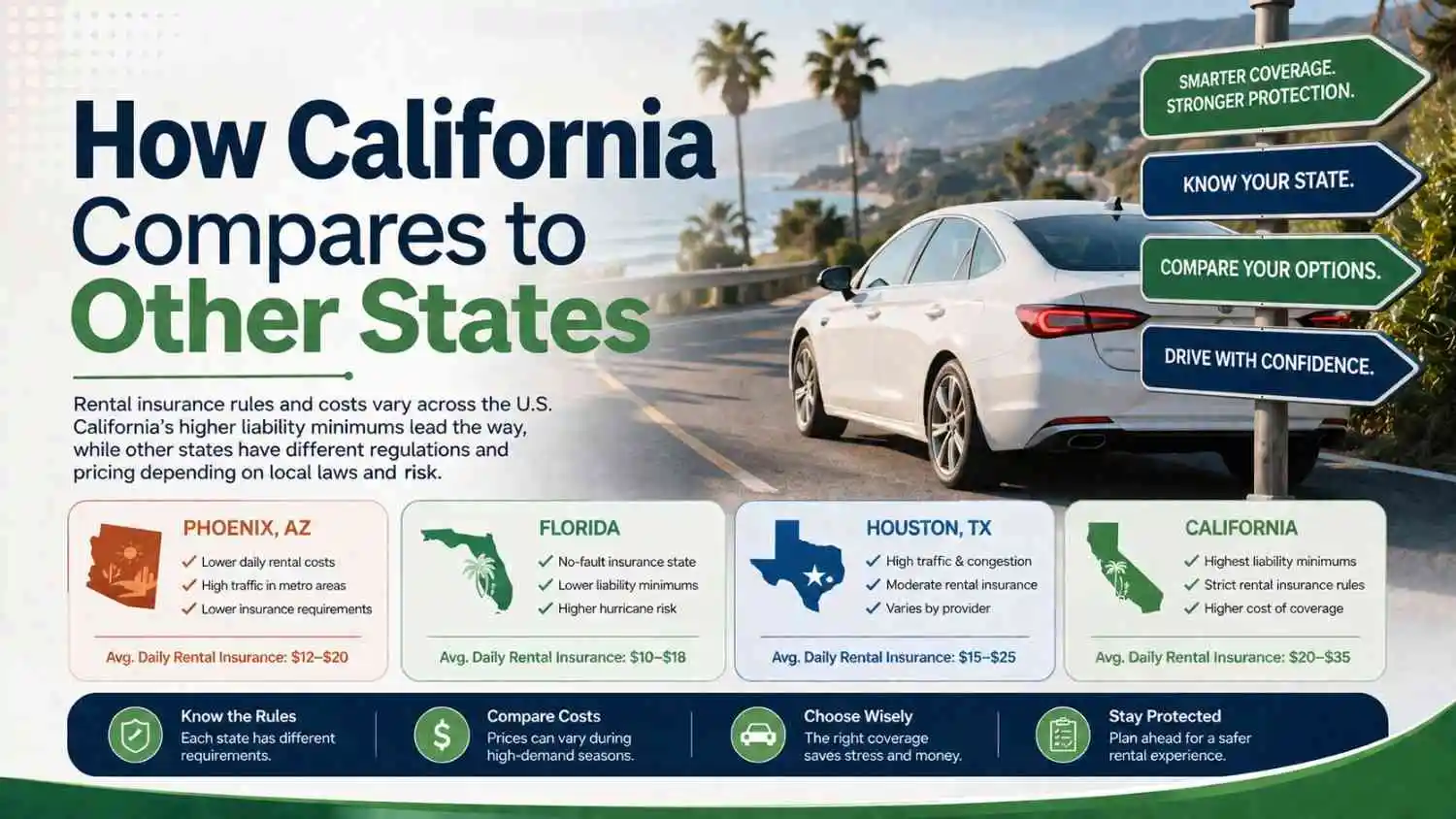
Rental insurance rules and typical costs shift depending on where you’re renting. California’s newly raised liability minimums put it ahead of many states that still operate on decades-old thresholds. For comparison, drivers researching rental insurance rules elsewhere in the country often look at Florida’s requirements, where our article on the minimum auto insurance requirements in Florida outlines a very different regulatory structure, including its no-fault framework.
Renters comparing costs across major cities sometimes also look at how rental and personal auto pricing differ regionally. Reviewing cheap auto insurance in Phoenix shows how a lower-cost state compares on daily driving expenses.
Traffic density and state law also shape what a “reasonable” daily rate looks like elsewhere. Our guide to choosing car insurance in Houston highlights how one of the country’s busiest metro areas handles similar coverage decisions.
If you’re the kind of traveler who rents cars often across different states, it’s worth keeping an eye out for our upcoming piece on How Rental Car Insurance Rules Differ From State to State, which we’re planning to cover in more depth soon. We’re also working on a dedicated guide called What to Do If Your Rental Car Is Damaged or Stolen in California, walking through the claims process step by step.
Why the Right Coverage Matters More Than the Cheapest Option
It’s tempting to treat rental insurance as a line item to minimize, but the math only works in your favor if you’re actually covered elsewhere. A totaled economy rental can run $15,000 to $25,000 in repair or replacement costs. If your personal policy doesn’t extend to rentals, or your credit card benefit turns out to be secondary rather than primary, declining a $20-a-day waiver to save money on a five-day trip could end up costing you the equivalent of several years of coverage in a single incident.
The opposite mistake costs less dramatically but still adds up. Paying $40 to $60 a day for a full bundle you didn’t need on a two-week trip is an extra $560 to $840 that never needed to leave your wallet. Neither extreme is the goal. The goal is matching what you buy to what you’re missing, which is really the whole point of checking your existing coverage first.
Smart Rental Car Insurance Choices for Drivers in California
Making a smart choice about car rental insurance in California isn’t about buying more coverage. It’s about buying the right coverage for the gaps your existing policies don’t already fill. Most of the cost renters pay at the counter comes down to skipping a five-minute check of their personal auto policy and credit card benefits beforehand. Take that step first, understand what California’s liability minimums actually mean for your situation, and you’ll walk away from the counter with a decision you can explain, rather than one made under pressure. For more guidance on comparing coverage options and making sense of California’s insurance rules, Insurance Centrik puts together practical, no-pressure breakdowns to help you protect your trip without overpaying for it.
FAQs
Is credit card rental coverage enough on its own?
It depends on whether the benefit is primary or secondary, and whether it includes liability protection. Many card benefits only cover vehicle damage and theft, not injuries or property damage to others, so pairing it with adequate personal liability coverage is still worth considering.
Does my personal auto insurance cover a rental car in California?
In most cases, yes, if your policy already includes collision and liability coverage. Coverage typically does not extend to international rentals, business use, or rentals exceeding 30 days, so it's worth confirming directly with your insurer before you travel.
Do I need extra coverage for a one-day rental?
It depends more on your existing policy gaps than the rental length itself. A single day carries the same basic risks as a week-long rental — what matters is whether your personal insurance and credit card already fill those gaps.
How much does a collision damage waiver cost in California?
Rates typically range from about $15 to $42 per day for standard vehicles, though luxury and specialty vehicles can push daily rates significantly higher depending on the rental company and pickup location.

Aarvith is the author and founder of Insurance Centrik. He researches various insurance topics, including auto, health, travel, home, and business insurance. He provides accurate insurance information from reliable sources and industry expertise.