
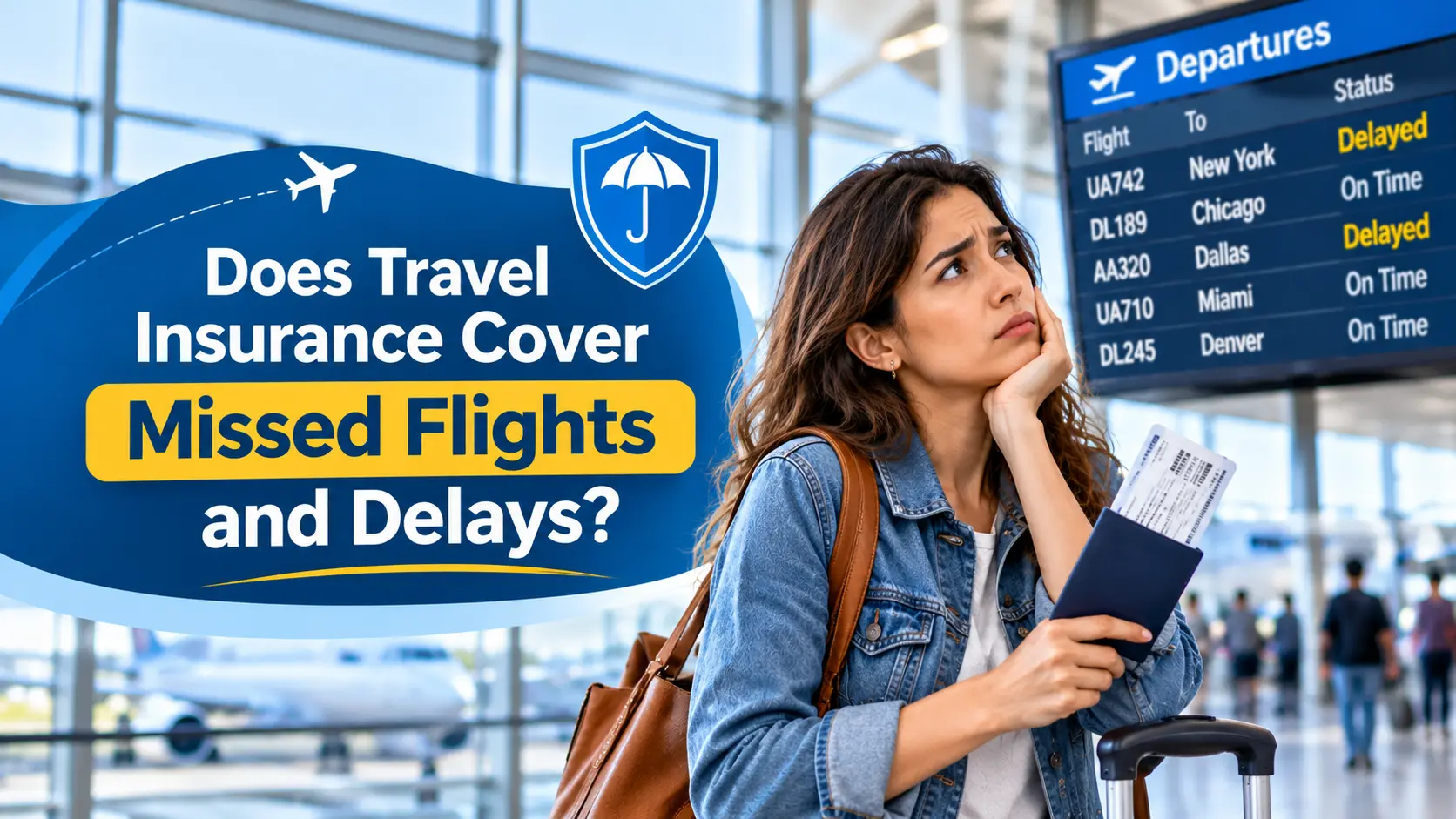
If you are in a cab, stuck in heavy traffic, and your flight is leaving in 70 minutes, missing your departure can become a real concern. Or perhaps your first flight is delayed, and you arrive at the connecting gate just as boarding has closed. In either situation, one question comes to mind: Will travel insurance cover the extra costs of a missed flight?
The honest answer is “sometimes.” Whether travel insurance covers missed flights works in your favor depends on why you missed the flight, what your policy wording says, and what proof you can show afterward.
At Insurance Centrik, we believe travelers should know what their insurance actually covers before starting a trip. Missing a flight or dealing with unexpected delays can be stressful and expensive. Here, we explain when travel insurance may help, what expenses it can cover, and where coverage has its limits.
Is a Missed Flight Covered?
Travel insurance can pay when you miss a flight, but only if the cause is on your policy’s covered list. Common covered causes include:
- A late first flight that makes you miss your connection
- A road accident or vehicle breakdown on the way to the airport
- Severe weather that closes roads or airports
- A sudden illness or injury
- A strike that stops public transport or airport staff
Common causes that are not covered include oversleeping, normal traffic, wrong departure times, and arriving after check-in closed for no good reason.
How Insurers Decide If Your Claim Is Valid
Claims teams usually ask four simple questions:
- Was the cause covered? It must match a reason in your policy.
- Was it outside your control? Events like accidents and storms qualify. Poor planning does not.
- Did you act sensibly? Did you leave early enough and react quickly once things went wrong?
- Can you prove it? Reports, receipts, and airline letters carry a lot of weight.
If all four answers are yes, your claim has a strong chance. If even one is shaky, expect questions or a refusal.
What Missed Flight Insurance Coverage Really Looks Like
Many travelers assume every plan has one clear “missed flight” benefit. It rarely works that way. Missed flight insurance coverage is usually spread across several benefits with different names, such as:
- Missed departure
- Missed connection
- Travel delay
- Trip interruption
- Trip cancellation
Each one has its own rules, limits, and waiting periods. A basic plan might pay a small daily amount while you wait for the next flight. A stronger plan might refund a full replacement ticket plus hotel and meals.
If you are still comparing travel insurance plans, look for the exact benefit names in the policy wording. The marketing page may promise “flight protection,” but the wording tells you what is really included.
Travel Insurance for Missed Departure: When It Pays
Travel insurance for missed departure covers you when you cannot board your first flight because of a covered event. Insurers usually want these things to be true:
- The cause is listed – Accidents, serious illness, extreme weather, and certain strikes are common ones.
- You planned a sensible buffer – Leaving home with barely enough time makes a claim harder.
- You can prove what happened –A police report, tow receipt, doctor’s note, or news report can all help.
- You bought the policy first – Cover bought after the problem starts will not respond.
Example: Missing a Flight Due to a Road Closure
Take Mark, who is flying from Chicago to Cancun out of O’Hare. A truck overturns on I-90 ahead of his rideshare, and the highway is shut for three hours. He misses his flight.
If his policy has a missed departure benefit, he could claim a new ticket up to the policy limit, an extra hotel night if the next flight is the following day, and meals and ground transport while he waits. He would need the Illinois State Police report or local news coverage of the closure, the rideshare receipt, and both tickets. Without paperwork, even a fair claim can stall.
What “Reasonable” Means
Insurers love the word “reasonable,” and it is where many arguments start. In practice, it means:
- You reached the airport in the time your airline recommends, often three hours before an international flight and two hours before a domestic one
- You called the airline as soon as you knew there was a problem
- You booked the next sensible flight instead of waiting around
If you can show that, you are on solid ground.
Missed Connection Coverage: The Part That Confuses People
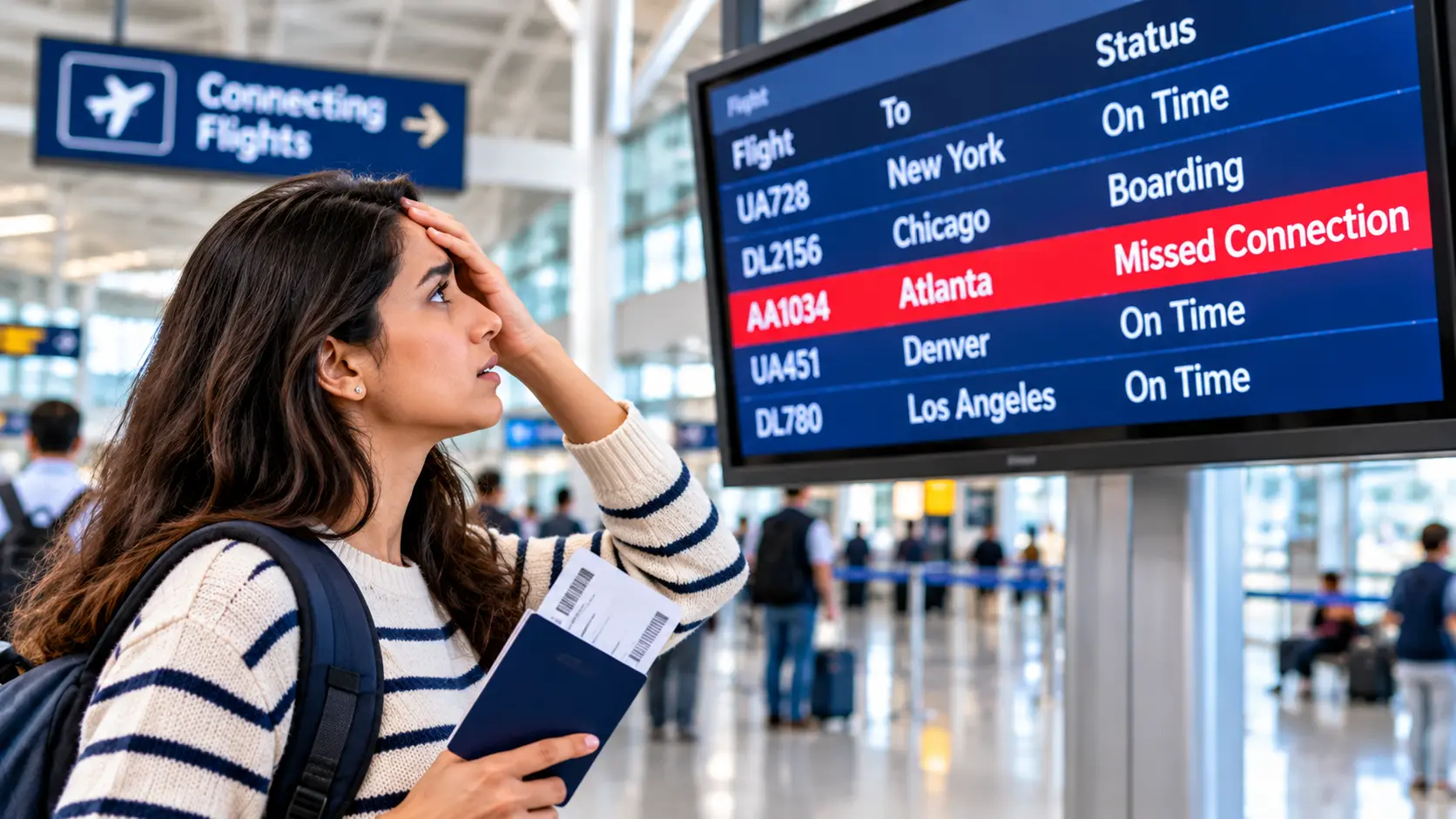
Missed connection coverage causes more confusion than any other flight benefit, because the result depends on how you booked your tickets and what caused the delay.
When It Usually Applies
You miss your second flight because your first flight landed late. The reason might be weather, a technical fault, air traffic control, or a crew issue. Most plans will respond if:
- Both flights are on the same booking reference
- The first flight’s delay lasted long enough to meet your policy’s minimum, often three to six hours
- The original schedule gave you a reasonable gap between flights
The Separate Ticket Problem
Say you booked flight one with a budget airline and flight two with a full-service carrier. If flight one runs late, the second airline sees you as a no-show. It owes you nothing.
Insurance may help in this case, but not always. Some policies exclude missed connections on separate bookings. Others pay only when the first delay was caused by a covered reason. If you build your own itinerary, read this part of the policy twice, and leave at least four to five hours between flights where you can.
What You Could Get Back
An approved claim may cover:
- A new ticket to your final stop
- Hotel costs while you wait
- Meals and local transport
- Phone calls to rebook or tell people about the delay
Always check the daily cap and the overall cap. A policy that pays $50 per day will not stretch far in an expensive city.
Replacement Flight Reimbursement: What Gets Paid
Replacement flight reimbursement is the money you get back for a new ticket after a covered missed flight. It sounds simple, but a few details decide the amount.
The Airline Comes First
Before you buy anything, speak to the airline. If the airline caused the delay or cancellation, it may rebook you for free. In some regions, such as the EU and UK, airlines have legal duties to offer rebooking or refunds in certain situations.
Insurers expect you to claim from the airline first. If the airline pays, the insurer will not pay for the same loss again. Insurance is there for the gap that the airline leaves behind.
What Counts as a Fair Replacement
Most insurers will repay a ticket that is:
- In the same cabin class as your original
- The next reasonable option, not a flight three days later by choice
- Bought at a normal fare
If you were in economy and book business class because you were frustrated, the insurer will cap the payment at the economy price, or refuse it.
Keep These Papers
- Your original booking confirmation
- The new ticket receipt
- Any letter or message from the airline about the delay
- Proof of what the airline refunded, if anything
A claim with receipts is a claim. A claim without them is a story.
Travel Delay Benefits: When the Flight Is Just Late
Not every disruption ends in a missed flight. Sometimes the plane just leaves many hours late. This is where travel delay benefits come in.
How They Work
Travel delay benefits start paying once your delay passes a set waiting period, often between 6 and 12 hours. After that, your plan may give you:
- A fixed daily amount, up to a maximum
- Repayment for hotel, food, and transport
- Money for basic items like toiletries if your bags are delayed too
These benefits are about extra costs and comfort. They do not replace the flight.
The Waiting Period Trap
If your policy says six hours and your flight is delayed five hours and forty minutes, you are not eligible. Insurers draw hard lines, and they do not round up. Cheaper plans often need 12 hours of delay, while better ones may start at three or six. If you travel for work or have tight plans, a shorter waiting period is worth paying for.
Reasons That Usually Count
- Bad weather
- Mechanical failure
- Strikes
- Air traffic control problems
- Natural disasters
Some policies list these clearly. Others use broad words like “unforeseen events.” If the cause is not covered, the delay might not be either.
Delay, Cancellation, and Missed Flight Are Not the Same
- Delay: the flight still goes, just later
- Cancellation: the airline scraps the flight
- Missed flight: the plane leaves and you are not on it
Each situation may qualify for a different insurance benefit. If your policy also includes trip cancellation coverage, check whether it covers airline cancellations, cancellations due to covered personal reasons, or both. These situations are treated differently under most travel insurance policies.
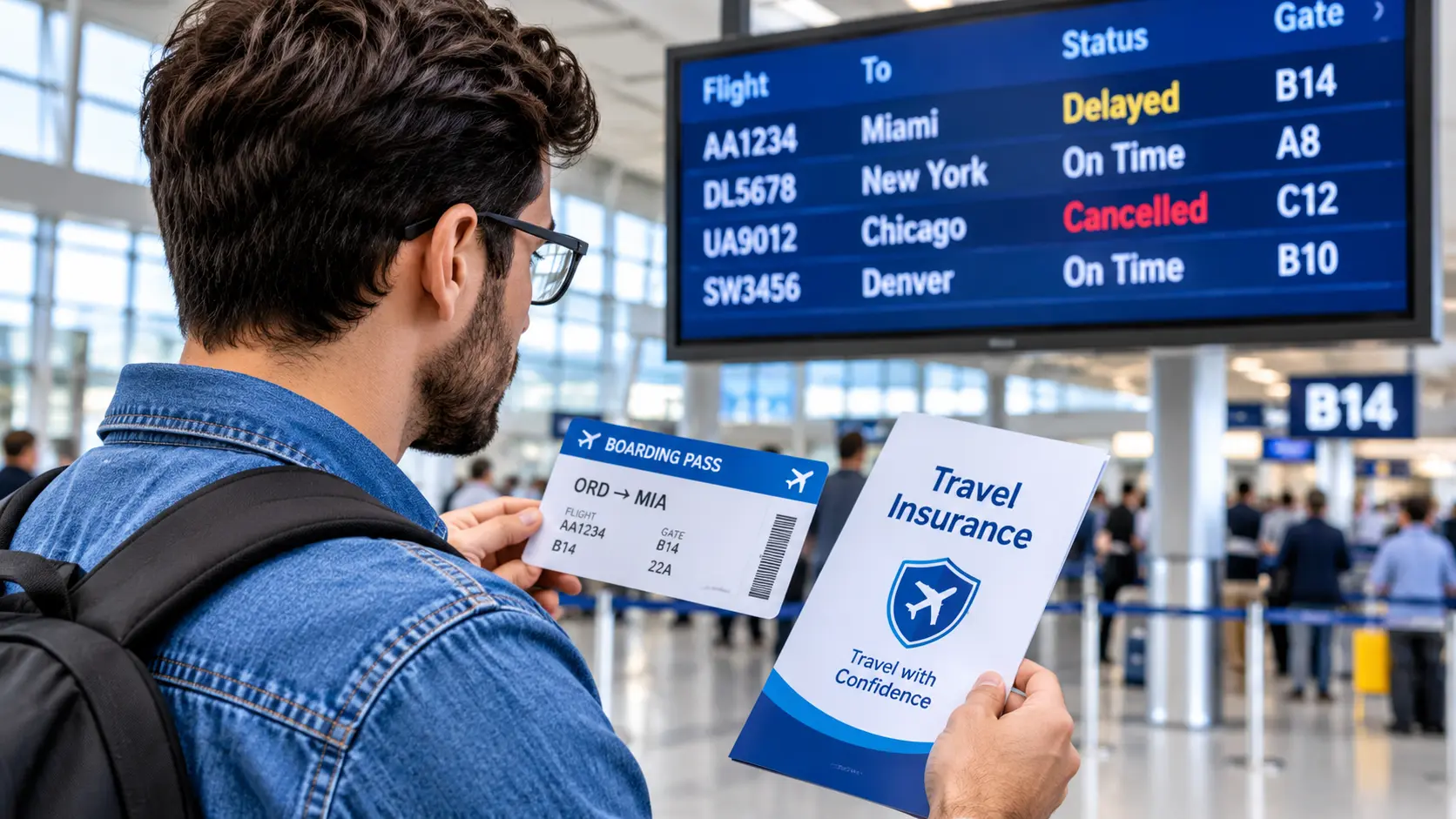
Missed Flight Exclusions: The Fine Print That Sinks Claims
This section can save you money and stress. Missed flight exclusions are the situations your policy will not pay for, however bad the day was.
- Personal mistakes – Oversleeping, reading the wrong time on your ticket, forgetting your passport, or going to the wrong terminal.
- Normal traffic – A busy road is not an emergency. An accident or road closure is a different story.
- Late arrival at the airport – If you reach the desk after check-in closes with no covered reason, expect a refusal.
- Pre-existing medical conditions – If an old condition makes you miss the flight, many plans exclude it unless you bought a waiver.
- Document problems – Expired passports, missing visas, and denied boarding for paperwork reasons are usually excluded.
- Airline-owed compensation – If the law makes the airline pay, the insurer will not pay twice.
- Change of mind or fear of flying – Unless you bought cancel-for-any-reason cover, these are not covered.
- Self-made tight connections – Giving yourself 45 minutes between international flights on separate tickets is a risk insurers will not take on.
- Alcohol or drugs – If you miss the flight because you were intoxicated or refused boarding for it, the claim will fail.
Cancel For Any Reason (CFAR)
This upgrade lets you cancel your trip for reasons outside the normal list, usually for 50% to 75% of your non-refundable costs. You normally must buy it soon after your first trip payment and cancel a set number of days before departure. It will not fix a missed flight on the day, but it helps when your reason is not on the standard list.
Better Delay Limits
Some insurers let you pay a bit more to start delay benefits after three hours instead of twelve, or to raise the daily limit. When you compare a travel insurance policy for a complicated route, this is one of the first upgrades to price.
Credit Card Benefits
Many premium cards include basic delay and missed connection cover if you pay for the trip with that card. These can help, but limits are often lower and claim rules stricter than a standalone plan. Check the card’s benefit sheet before you count on it.
How to Claim After a Missed Flight
A strong claim is built while the problem is still happening.
Step 1: Talk to the airline – Ask for rebooking and ask what they will cover. Note the agent’s name and the time.
Step 2: Call your insurer’s emergency line – Many run 24 hours. They can sometimes approve spending before you make it.
Step 3: Collect proof on the spot – Photograph departure boards, save airline messages, and ask for a written delay or cancellation letter.
Step 4: Keep every receipt – Meals, hotels, transport, tickets, and calls. Snap photos right away so you do not lose paper copies.
Step 5: File quickly – Most insurers set a deadline, often 30 to 90 days. Late filing is a very common reason for refusal.
Step 6: Tell the story straight – Describe events in order and avoid exaggeration. Claims teams check details, and honest claims move faster.
Documents You May Need
- Policy number and proof of purchase
- Tickets and booking confirmations
- Boarding passes, if issued
- Airline delay or cancellation letter
- Police, medical, or breakdown reports where relevant
- Receipts for extra costs
- Card or bank statements as backup
Mistakes That Lead to Denied Claims
After seeing many disputes, these are the errors that cost travelers the most:
- Buying too late – Cover for weather or strikes may not apply once the event is announced.
- Skipping the exclusions page – The benefits page is shiny. The exclusions page is where the truth lives.
- Not asking the airline first – Insurers want proof you tried.
- Overspending – A $400 hotel when a $120 one was next door will be trimmed.
- Missing receipts – No receipt, no refund.
- Reporting late – Some policies require notice within a short window.
- Trusting the credit card too much – It rarely covers as much as people expect.
- Booking tight connections on separate tickets –Insurers treat that as a risk you chose.
How to Choose a Policy That Covers Flight Problems
Use this checklist when comparing plans:
- Look for named benefits: missed departure, missed connection, travel delay, and trip interruption
- Check the waiting period for delay benefits, since shorter is better
- Check daily and total limits against real hotel and food prices at your destination
- Read how the policy defines a missed connection, including whether it needs one ticket
- Review the list of covered reasons, because a wider list is better
- Read the exclusions and compare them with how you travel
- Ask about pre-existing condition waivers if they apply to you
- Check for a 24-hour helpline and online claims
- Read recent customer reviews about how claims were handled
A cheap policy looks good until the day you need it. A slightly better one with clear missed flight insurance coverage can save you hundreds. If you want to compare travel insurance benefits side by side, check each benefit name against the checklist above.
Habits That Lower Your Risk
Insurance is a safety net, not a plan. A few habits reduce your odds of needing it:
- Arrive three hours early for international flights and two for domestic ones
- Leave at least three hours between connecting flights
- Check your flight status the night before and again in the morning
- Book connecting flights on one ticket when possible
- Install your airline’s app for live alerts
- Check road and rail conditions before leaving
- Save a copy of your policy and the emergency number on your phone
- Buy your policy soon after booking, not the night before you fly
Three Quick Scenarios
The late inbound flight: Your first flight lands two hours late because of a storm, and you miss your connection on the same ticket. The airline rebooks you for free. Your insurer may still pay for a hotel night and meals if your plan has missed connection coverage.
The flat tyre: Your car breaks down on the way to the airport, even though you left with plenty of time. You have the repair receipt. A missed departure benefit may refund a new ticket.
The alarm that never rang: You overslept and reached the airport after check-in closed. Nearly every policy sees this as your own mistake, so the claim will likely be refused.
The pattern is simple. If the cause was outside your control and you can prove it, you have a case. If it came down to your own error, you probably don’t.
Missed a Flight? What to Remember Before You Claim
So, does travel insurance cover missed flights? Yes, when the reason is a covered one and your plan includes the right benefit. It can pay for replacement flights, hotel stays, meals, and local transport. It will not rescue you from oversleeping, long queues, or tight planning.
The best protection mixes three things: a policy with clear missed departure and missed connection benefits, a careful read of the exclusions, and smart habits on travel day. Contact the airline first, keep your receipts, and file your claim on time.
If you are choosing a plan right now, Insurance Centrik can help you read the fine print so the policy you buy fits the trip you are taking.
FAQs
What is missed connection coverage in travel insurance?
It pays extra costs like a new ticket, hotel, and meals when a delayed first flight makes you miss your next one. Most plans need both flights on one booking and a minimum delay length.
Does travel insurance cover missed flights because of traffic?
Only in some cases. Normal heavy traffic is usually excluded. A jam caused by an accident or road closure, backed by proof, may be covered under a missed departure benefit.
Will travel insurance pay for a replacement flight?
It can. Replacement flight reimbursement usually covers a new ticket in the same class as your original after a covered missed flight. Keep receipts and show that the airline did not rebook you for free.
What should I do first if I miss my flight?
Contact your airline right away to ask about rebooking, then call your insurer's emergency line. Keep all receipts, delay letters, and proof of what happened, and file your claim before the deadline in your policy.

Aarvith is the author and founder of Insurance Centrik. He researches various insurance topics, including auto, health, travel, home, and business insurance. He provides accurate insurance information from reliable sources and industry expertise.