

Getting life insurance is not always straightforward, especially for older adults or people who have had difficulty qualifying because of their health history. Guaranteed issue life insurance offers another route. It generally does not require a medical exam or health questions, making the application process simpler than traditional medically underwritten coverage.
That convenience comes with tradeoffs. Premiums can be relatively high for the amount of coverage purchased, benefit amounts are usually modest, and many policies limit the death benefit for non-accidental death during the first few policy years.
For that reason, guaranteed issue coverage is usually worth comparing with other life insurance options before applying. The easiest policy to qualify for is not necessarily the policy that provides the best value.
What Is Guaranteed Issue Whole Life Insurance?
Guaranteed issue whole life insurance is permanent life insurance generally available without a medical exam or health questionnaire. Instead of evaluating an applicant’s medical history to determine acceptance, the insurer uses a much simpler eligibility process.
“Guaranteed issue” does not mean that every person automatically qualifies for every policy. Applicants still have to meet the insurer’s basic requirements. These may include an eligible age range, residence in a state where the product is offered, and compliance with the insurer’s application rules.
Most guaranteed issue policies are whole life policies. Unlike term insurance, which lasts for a specified period, whole life coverage is designed to remain in force for the insured person’s lifetime as long as required premiums are paid and the policy remains active.
This is one reason age can matter so much. Whole life premiums are generally based partly on the age at which coverage begins, so looking at whole life insurance rates for seniors can provide useful context when comparing guaranteed issue coverage with other permanent policies.
What Does “Guaranteed Acceptance” Really Mean?
The term can sound broader than it actually is.
With a true guaranteed issue policy, the insurer generally does not use medical questions or an exam to determine whether an otherwise eligible applicant can obtain coverage. A serious health condition, by itself, generally does not trigger the same underwriting process used for traditional life insurance.
However, insurers can establish non-health eligibility requirements.
Depending on the policy, these can include:
- Minimum and maximum application ages
- State availability
- Permitted coverage amounts
- Residency requirements
- Required application information
- Premium payment requirements
The exact rules are insurer-specific and sometimes state-specific. A consumer should verify them directly in the application and policy documents rather than assuming the word “guaranteed” removes every restriction.
How Does Guaranteed Issue Life Insurance Work?
Guaranteed issue life insurance removes much of the medical underwriting from the application, but the insurance contract itself still works much like other permanent life insurance.
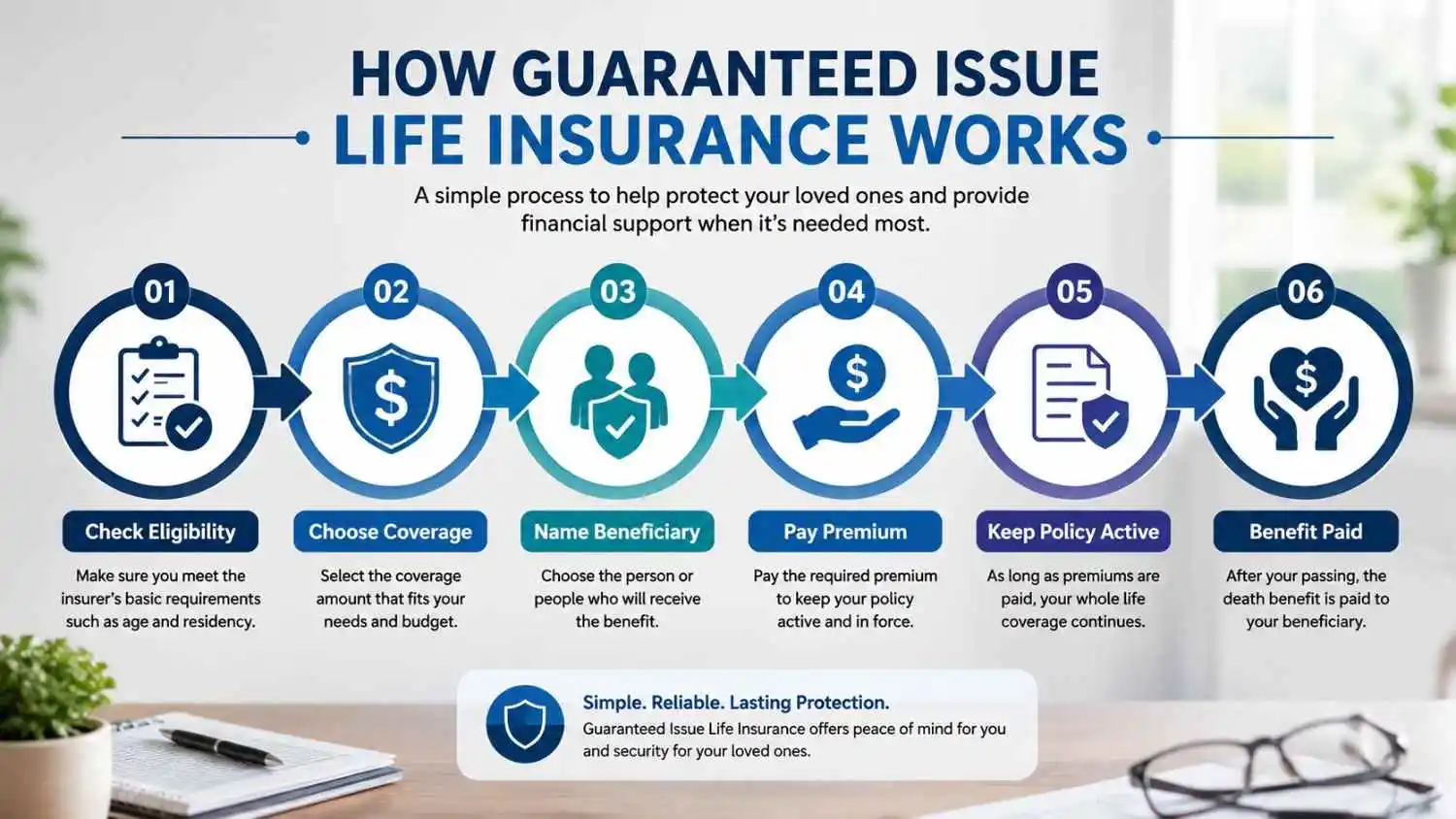
Here is what usually happens.
1. You Check Whether You Are Eligible
The first step is confirming the insurer’s basic eligibility requirements. Age is particularly important because these products are usually offered only within a defined age range.
2. You Select a Coverage Amount
The amount of insurance purchased is called the face amount. If you buy a $10,000 policy, for example, $10,000 is the stated face amount.
Guaranteed issue policies usually provide smaller face amounts than traditional life insurance. They are often purchased for funeral expenses, medical bills, small debts, or other costs that could remain after death rather than for replacing decades of income.
3. You Name a Beneficiary
A beneficiary is the person or entity designated to receive the policy proceeds after the insured person’s death, subject to the terms of the contract and the insurer’s claims process.
The beneficiary generally controls how the money is used after it is paid unless a specific assignment or other arrangement applies.
4. You Pay the Required Premium
The premium is the amount paid to keep the insurance in force. Guaranteed issue whole life policies commonly have level premiums, meaning the scheduled premium does not increase simply because the insured gets older.
Consumers should still verify the actual premium structure in the contract. “Level premium” does not mean coverage continues without payment.
5. Coverage Remains Active Under the Policy Terms
As long as required premiums are paid and the policy remains in force, whole life coverage is designed to continue for life rather than ending after a fixed term.
If premiums stop, a grace period or other policy provisions may temporarily apply. Eventually, however, a policy can lapse if the required payment is not made.
6. The Applicable Benefit Is Paid After Death
After the insured dies, the beneficiary submits a claim. The amount payable depends on the contract and can be affected by a graded death benefit if death occurs during the policy’s early years.
This is one of the most important parts of guaranteed issue coverage to understand before applying.
Guaranteed Issue Life Insurance for Seniors: Who Qualifies?
Guaranteed issue life insurance for seniors is primarily designed for older adults who want permanent coverage without going through traditional medical underwriting.
There is no single guaranteed issue life insurance age limit that applies to every U.S. insurer. One company might offer a product through age 80, while another may accept applications at older ages. Minimum ages can differ as well.
Eligibility can also vary by state because insurance products and policy forms are regulated at the state level.
Someone over 70 who wants only enough coverage for funeral expenses, for example, may encounter guaranteed issues alongside simplified issue options while comparing final expense insurance for seniors over 70. The two should not automatically be treated as interchangeable because their underwriting and early death benefits can differ.
Who Might Consider This Coverage?
Guaranteed issue may deserve consideration when a person:
- Has been unable to qualify for medically underwritten life insurance
- Wants a small permanent death benefit
- Does not want to complete a medical exam
- Cannot qualify for a simplified issue policy
- Needs coverage primarily for final expenses
- Falls within the insurer’s eligible age range
A previous life insurance decline does not automatically mean guaranteed issue is the only remaining choice. Insurers have different underwriting standards, and another company may evaluate the same applicant differently.
Life Insurance With No Medical Exam Is Not Always Guaranteed Issue
The phrase life insurance with no medical exam can cause confusion because several different types of insurance may skip the physical exam.
Guaranteed issue normally goes a step further by eliminating health questions as part of the acceptance process.
| Feature | Guaranteed Issue | Simplified Issue | Traditional Underwritten |
| Medical exam | Generally no | Usually no | May be required |
| Health questions | Generally no | Usually yes | Yes |
| Health-based approval | Generally no | Yes | Yes |
| Coverage amounts | Usually smaller | Often higher | Often much higher |
| Cost per $1,000 | Often higher | Can be lower | Often lower for healthy applicants |
| Graded benefit | Common | Depends on policy | Less common |
| Application process | Simple | Relatively simple | More detailed |
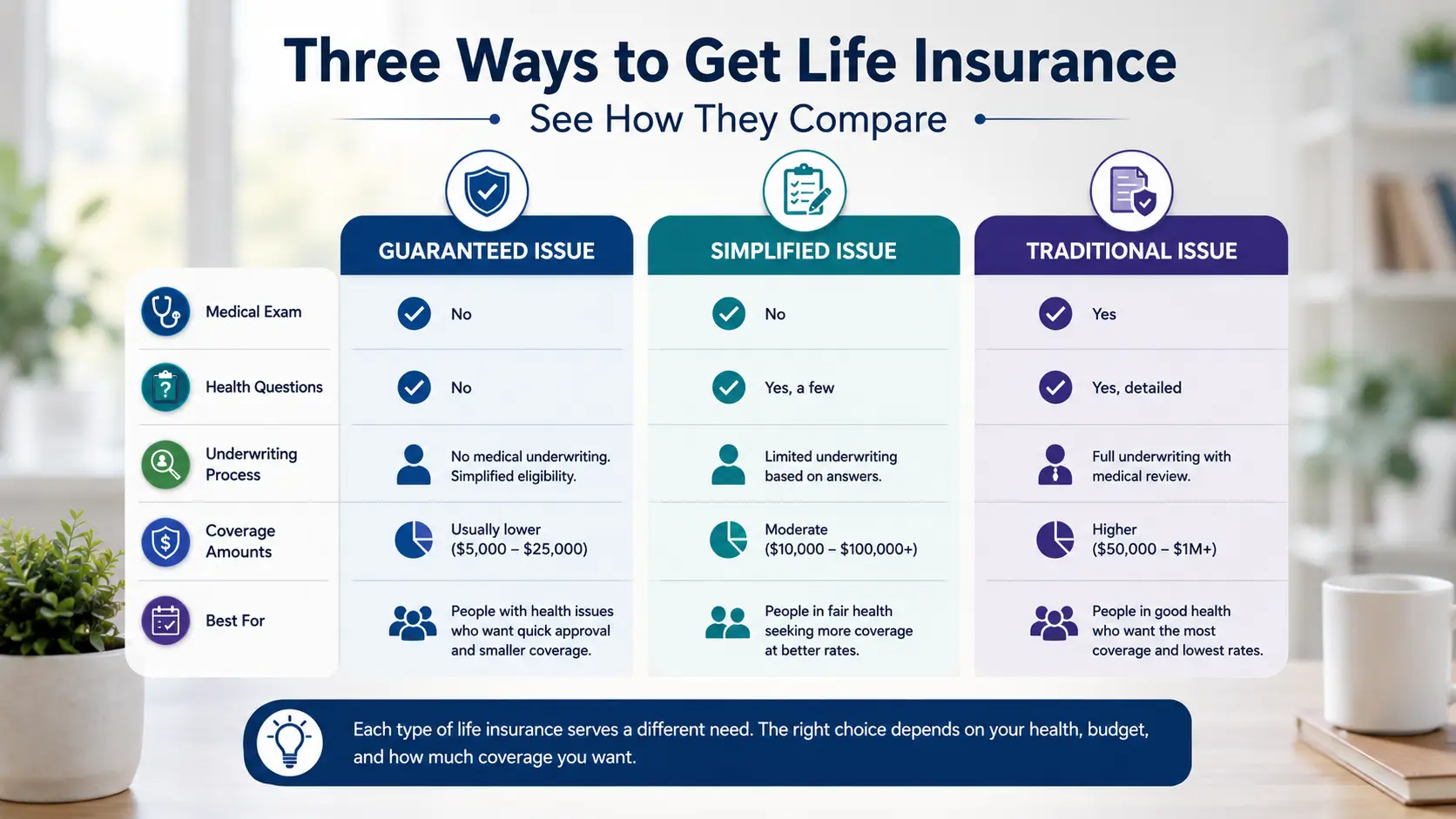
For a senior in reasonably stable health, no medical exam life insurance for seniors with limited health questions may provide better value than jumping directly to guaranteed acceptance.
The health questions are not necessarily a disadvantage. If answering them allows an applicant to qualify for a lower premium or immediate full death benefit, accepting some underwriting can work in the consumer’s favor.
Why the Graded Death Benefit Matters
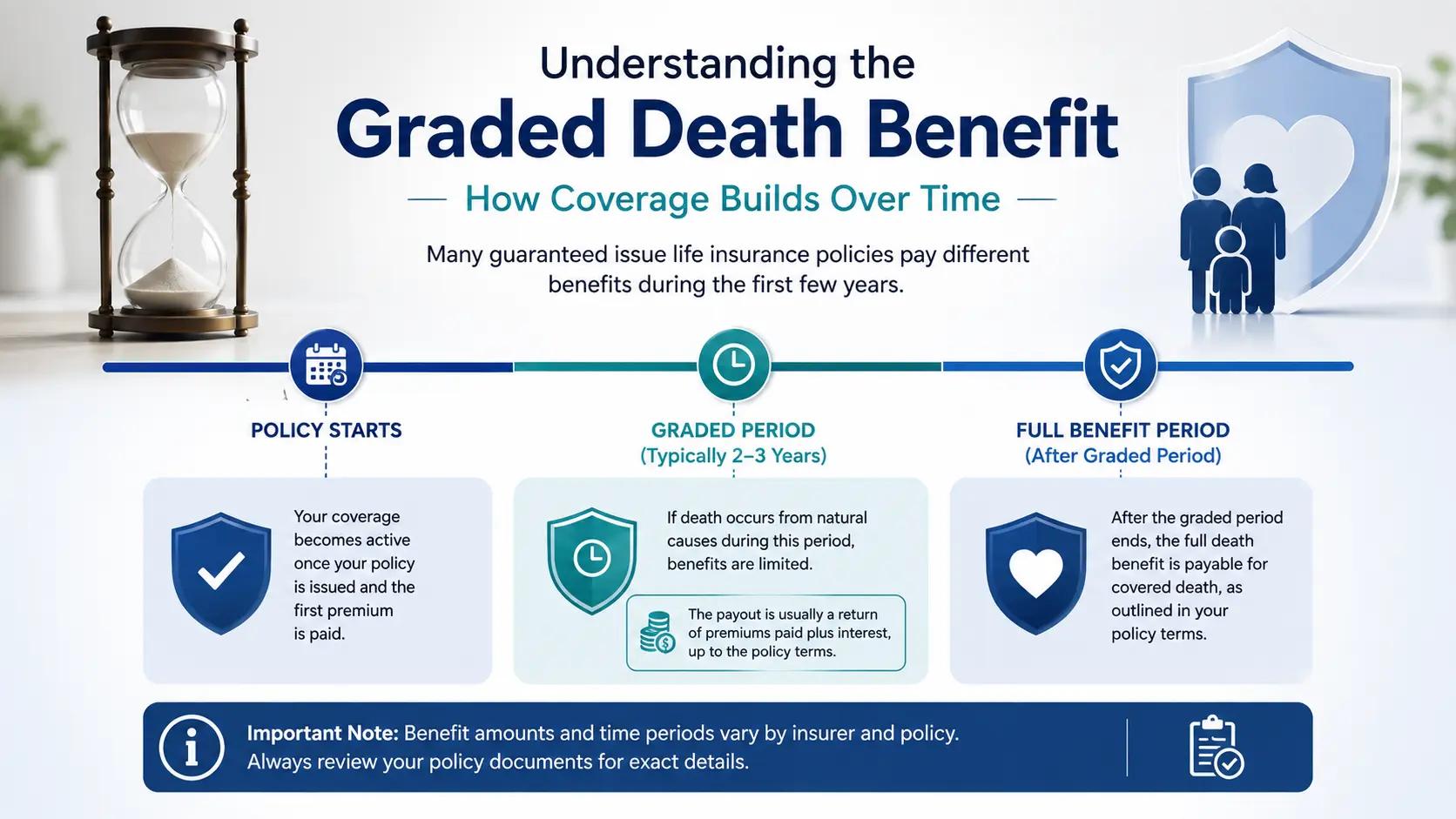
A graded death benefit can limit the payout during the first few policy years. If a policyholder dies from a non-accidental cause during this period, the beneficiary may receive the premiums paid plus an additional amount instead of the full death benefit.
The exact waiting period and payout rules depend on the insurer and policy. Some applicants may qualify for burial insurance with no waiting period, which can provide the full death benefit from the start for covered causes, subject to policy terms and exclusions.
Guaranteed Issue Life Insurance Cost by Age
The guaranteed issue life insurance cost depends on several factors, including the applicant’s age, sex or gender rating classification where permitted, coverage amount, insurer, state, and individual product.
Health normally does not produce the same pricing advantage it can with medically underwritten insurance. The insurer is accepting a broader pool of health risks, which is one reason guaranteed issue coverage can cost more per $1,000 of death benefit.
The table below provides an example of how premiums can change with age.
Estimated Monthly Premium for $10,000 of Coverage
| Issue Age | Female | Male |
| 45 | $28 | $36 |
| 50 | $30 | $40 |
| 55 | $38 | $45 |
| 60 | $43 | $57 |
| 65 | $50 | $69 |
| 70 | $64 | $87 |
| 75 | $89 | $113 |
| 80 | $127 | $157 |
| 85 | $158 | $193 |
Note: These figures are approximate examples based on Mutual of Omaha’s published 2026 national rate chart for $10,000 of guaranteed acceptance whole life coverage (non-tobacco), rounded to the nearest dollar. Verified against the Mutual of Omaha official rate chart as of2026. They are not personalized insurance quotes or U.S. market averages. Current rates, eligibility, available coverage, rating classifications, and policy terms can differ by state and applicant. Always verify current pricing directly before purchasing coverage.
Guaranteed Issue Final Expense Insurance Explained
Guaranteed issue final expense insurance is usually a small whole life policy designed to leave money for funeral costs, medical bills, or other expenses after death. “Guaranteed issue” refers to how the policy is approved, while “final expense” describes its common purpose.
Not every final expense policy offers guaranteed acceptance. Some use simplified underwriting, which means applicants answer a few health questions but usually do not need a medical exam. Those who qualify may receive lower rates or immediate full coverage.
Other policies offer guaranteed acceptance but may include a graded death benefit during the first few years. This is why final expense insurance for seniors can differ in eligibility, cost, waiting periods, and benefits depending on the insurer and policy.
What Can the Death Benefit Cover?
Life insurance proceeds paid to an individual beneficiary are generally not restricted solely to funeral expenses unless a particular contractual arrangement or assignment applies.
Families might use the money for:
- Funeral home expenses
- Burial or cremation
- Cemetery expenses
- Medical bills
- Credit card balances
- Household expenses
- Small personal debts
This is also why the distinction between burial insurance vs life insurance is often more about coverage amount, purpose, and policy design than two completely unrelated financial products.
How Much Coverage Should You Consider?
Start with the financial problem you are trying to solve.
If your only goal is helping your family handle a funeral and a few remaining bills, a modest face amount may be enough. If your family depends on your income, however, a small guaranteed issue policy may be far too limited.
Consider expected expenses such as funeral services, burial or cremation, medical balances, small debts, and estate-related costs. Then subtract money already specifically available for those expenses.
For example, assume you expect approximately $15,000 in final expenses but already have $8,000 set aside. Your actual insurance needs may look very different from someone with no savings available.
Coverage designed primarily for funeral costs is also commonly sold as burial insurance for seniors, but the underwriting method should still be checked rather than assuming every burial policy provides guaranteed acceptance.
Advantages and Limitations to Consider
Guaranteed issue life insurance has a legitimate place in the insurance market, particularly for people who have limited options. Its accessibility, however, should be considered alongside its cost and benefit restrictions.
Advantages
No medical exam – Applicants generally do not need to schedule an insurance physical, blood test, or similar examination.
No health questionnaire – True guaranteed issue coverage generally does not use health questions to determine acceptance.
Permanent coverage – Because these policies are generally whole life insurance, coverage can remain in force for life when policy requirements are satisfied.
Level premiums – Many policies use scheduled premiums that remain level after issue.
Simple application – Removing medical underwriting can make the application process relatively straightforward.
Limitations
Higher cost for the coverage received – Guaranteed issue can be expensive on a per-$1,000 basis compared with coverage available to applicants who pass underwriting.
Smaller death benefits – These products are generally designed for modest financial needs rather than large income-replacement goals.
Graded death benefits – Many policies restrict benefits for non-accidental death during an initial period.
Age restrictions – Guaranteed acceptance does not remove minimum and maximum issue ages.
State differences – A policy advertised nationally may not have identical availability or terms in every state.
Limited value for healthy applicants – Someone who can qualify through health questions may find a better option elsewhere.
How to Compare Guaranteed Issue Policies
Two guaranteed issue policies with the same $10,000 face amount can still offer meaningfully different values.
Before applying, compare these areas.
1. Confirm the Eligible Age Range
Do not assume an age limit from one insurer applies to another. Check both minimum and maximum issue ages for the specific product.
2. Read the Graded-Benefit Schedule
Find out exactly what would be payable if death from a non-accidental cause occurs during year one or year two.
Ask for the policy language rather than relying solely on a marketing summary.
3. Compare the Same Face Amount
Comparing a $10,000 policy from one insurer with a $20,000 policy from another tells you little about relative value.
Use the same coverage amount when comparing premiums.
4. Check Simplified Issue Eligibility
Before accepting a guaranteed issue policy, determine whether answering limited health questions could qualify you for better terms.
You do not necessarily need a medical exam to obtain medically screened coverage.
5. Review Exclusions Carefully
Life insurance contracts contain exclusions and conditions. A suicide exclusion during an initial period is common, for example, but exact language and applicable state requirements vary.
Do not assume an advertisement contains every policy limitation.
6. Confirm the Premium Structure
Ask whether premiums remain level, how frequently payments are due, how long premiums must be paid, and what happens if a payment is missed.
7. Check State Availability
Life insurance is regulated at the state level. Policy forms, features, availability, and consumer protections can vary depending on where you live.
What Happens If the Policy Lapses?
If you stop paying the required premiums, your life insurance policy can eventually lapse after any applicable grace period ends. Once coverage ends, your beneficiaries may no longer receive the death benefit. Whole life policies with cash value may have other options, depending on the policy terms.
A lapse can be especially costly for older adults. Someone who loses coverage at 75 may pay considerably more for a new policy than they did at 65, and a new guaranteed issue policy could come with another graded-benefit period. Before buying, consider whether the premium will remain affordable over the long term.
Guaranteed Issue vs. Other Life Insurance Options
Guaranteed issue is only one way to obtain life insurance without a traditional medical exam.
| Policy Type | Health Questions | Medical Exam | Main Advantage | Main Limitation |
| Guaranteed issue | Generally no | No | Health-based acceptance is easier | Higher cost and graded benefits are common |
| Simplified issue | Usually yes | Usually no | Can offer better value | Approval depends on health answers |
| Fully underwritten | Yes | May be required | Better rates may be available | More extensive underwriting |
| Term life | Usually varies by product | May be required | Larger temporary coverage | Coverage ends after the term |
| Final expense whole life | Varies | Usually no | Designed for smaller final costs | Limited face amounts |
The key is to compare underwriting, not just product names.
A policy advertised as “no medical exam” may still ask health questions. A final expense policy may be simplified issue or guaranteed issue. A whole life policy can have very different coverage amounts and underwriting requirements depending on the insurer.
Questions to Ask Before You Apply
Insurance advertisements naturally focus on benefits. Consumers should spend just as much time looking at restrictions.
Before signing an application, ask:
- What is the exact monthly or annual premium?
- Is that premium scheduled to remain level?
- What is the face amount?
- Is there a graded death benefit?
- How is accidental death handled?
- What happens if I miss a premium?
- Does the policy accumulate cash value?
- Are there surrender charges or other relevant provisions?
- Is a simplified issue alternative available?
- Is the insurer licensed in my state?
Keep the policy illustration, application, disclosures, and final contract. If something in the issued policy differs from what you expected, contact the insurer or a licensed insurance professional and use any applicable free-look period according to the policy and state rules.
Deciding Whether Guaranteed Issue Coverage Fits Your Needs
Guaranteed issue life insurance can provide a practical path to permanent coverage for someone who cannot qualify through ordinary health underwriting. Its strongest advantage is accessibility, but that advantage needs to be weighed against higher costs per dollar of coverage, smaller face amounts, and graded death benefits.
Before buying, determine how much insurance you actually need, check whether simplified issue coverage is available, compare equivalent face amounts, and read the graded-benefit provisions carefully. Most importantly, choose a premium that can remain affordable for the long term.
Insurance decisions should ultimately be based on the actual policy contract and personal financial circumstances rather than an advertisement or estimated rate table. Insurance Centrik provides educational insurance information to help readers understand these differences, compare coverage more carefully, and know which questions to ask before making a decision.
FAQs
Does guaranteed issue life insurance require a medical exam?
Generally, no. True guaranteed issue policies are designed without a medical exam and typically do not ask health questions. Always confirm the requirements for the specific product being considered.
What is the guaranteed issue life insurance age limit?
There is no universal U.S. age limit. Minimum and maximum application ages vary by insurer and product, and availability can also differ by state.
Does guaranteed issue life insurance have a waiting period?
Many policies use a graded death benefit during approximately the first two policy years for non-accidental death. The period and payout formula are policy-specific, so consumers should verify the actual contract.
Can a guaranteed issue policy be canceled for missing payments?
Yes. Guaranteed acceptance does not eliminate the obligation to pay required premiums. If payments stop, applicable grace-period and policy provisions may apply before coverage eventually lapses.

Aarvith is the author and founder of Insurance Centrik. He researches various insurance topics, including auto, health, travel, home, and business insurance. He provides accurate insurance information from reliable sources and industry expertise.